Safe Use of Cough and Cold Products in Kids Under 6: What Parents Need to Know
 Jan, 22 2026
Every winter, parents face the same frustrating cycle: a runny nose, a wet cough, a fever, and a child who won’t sleep. It’s natural to reach for a bottle labeled "Children’s Cough & Cold"-but doing so could put your child at risk. For kids under six, over-the-counter cough and cold medicines aren’t just ineffective-they’re dangerous.
Why These Medicines Don’t Work for Young Kids
You might think, "If it helps adults, why not kids?" But children aren’t small adults. Their bodies process drugs differently. By age two, a child has only about 23% of the liver enzymes needed to break down common cough medicine ingredients like dextromethorphan. That means the drug sticks around longer, building up to toxic levels. The U.S. Food and Drug Administration (FDA) reviewed over 120 deaths and thousands of emergency room visits linked to these products between 1969 and 2006. No study has ever shown that these medicines reduce cough or congestion in kids under six.The Ingredients That Can Hurt Them
Most children’s cough and cold products mix four types of active ingredients:- Antihistamines (like chlorpheniramine or brompheniramine): Cause drowsiness, but can also trigger hyperactivity, hallucinations, or seizures in toddlers.
- Decongestants (like pseudoephedrine or phenylephrine): Raise blood pressure and heart rate. In young children, this can lead to irregular heartbeats or even stroke.
- Cough suppressants (like dextromethorphan): Can cause breathing problems, especially in kids under two.
- Expectorants (like guaifenesin): Aim to loosen mucus-but young kids can’t effectively cough it up, so it just sits in their airways.
What the Experts Say
The American Academy of Pediatrics (AAP), the FDA, the CDC, and the Mayo Clinic all agree: do not give OTC cough and cold medicine to children under six. The AAP’s position hasn’t changed since 2008. The FDA’s 2007 advisory warned that these products offer no benefit and carry serious risks. Even the Consumer Healthcare Products Association, which represents drug makers, agreed in 2008 to label all products with "Do not use in children under 4 years." But here’s the problem: labels aren’t always clear. A 2021 FDA inspection found that 22% of children’s cold products still didn’t have the proper warning. And many parents don’t read them. A 2022 survey found that 42% of parents of kids under six still gave these medicines because they believed it would help their child feel better faster.What You Can Do Instead
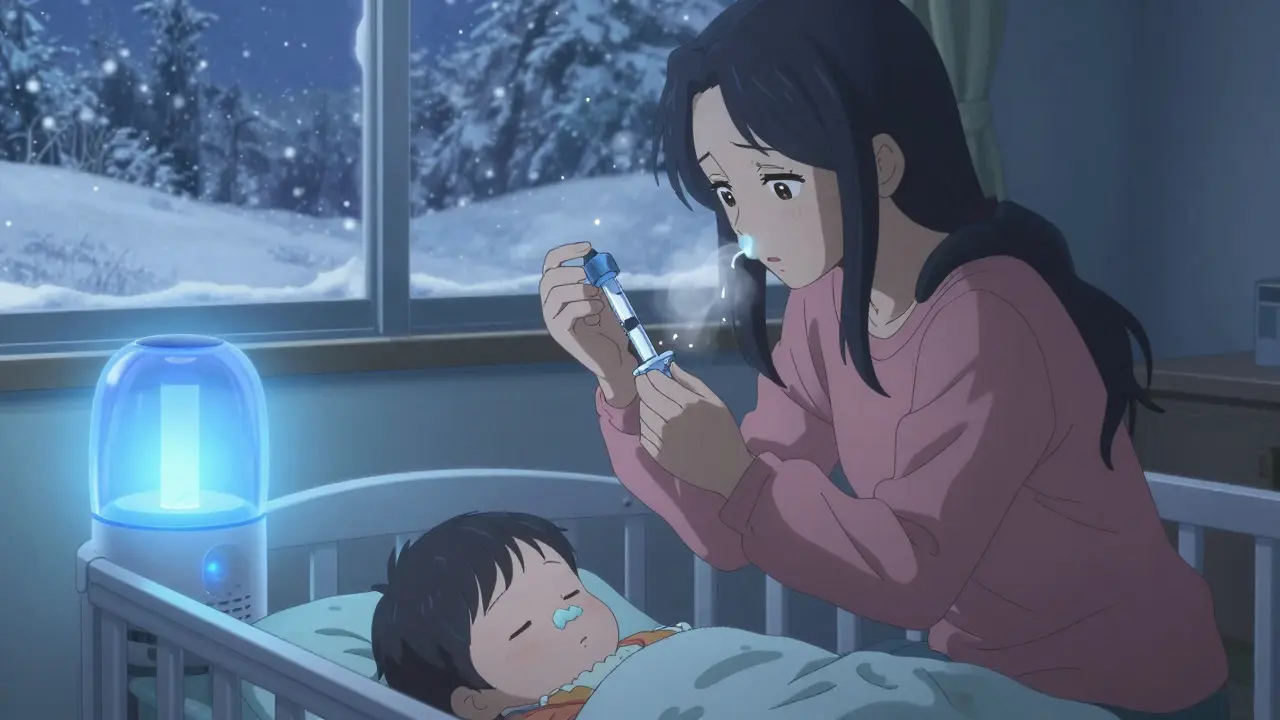
The good news? There are safe, proven ways to help your child feel better without pills.- For babies under 6 months: Use saline nasal drops and a bulb syringe to clear their nose. Run a cool-mist humidifier in their room. Keep them hydrated with breast milk or formula.
- For kids 6 months to 2 years: If they have a fever or pain, use acetaminophen (10-15 mg per kg of body weight) every 4-6 hours. Never give more than five doses in 24 hours. Avoid ibuprofen unless your doctor says it’s okay.
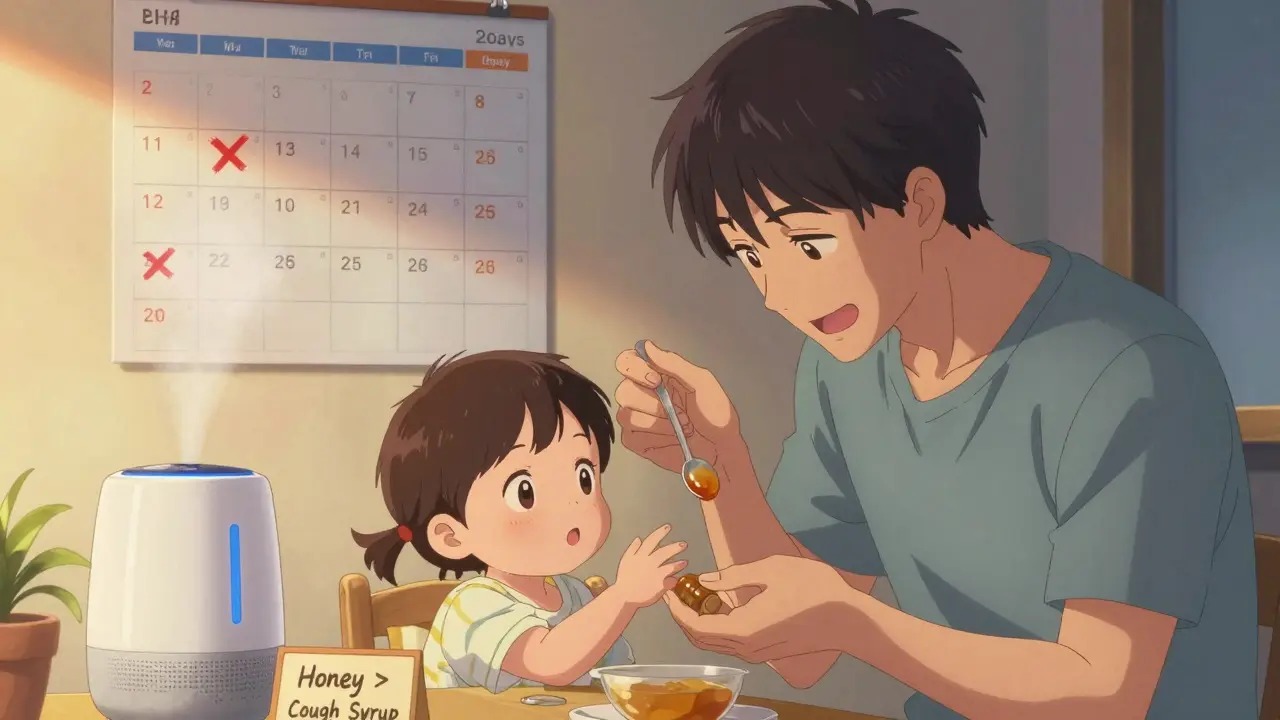
- For kids 1 year and older: One teaspoon of honey before bed can be more effective than any cough syrup. Honey coats the throat, reduces irritation, and helps them sleep. Studies show it works better than dextromethorphan for nighttime coughs.
- For all ages: Elevate the head of their crib slightly (place a towel under the mattress). Keep the air moist. Offer fluids often. A warm bath can help loosen congestion.
What Happens When You Give These Medicines Anyway?
Real stories from emergency rooms tell the truth. A 3-year-old in Ohio became hyperactive, couldn’t sleep for 12 hours after taking Children’s Dimetapp. A 2-year-old in Texas had a seizure after his grandmother gave him "just a little" of her cold medicine. Another child developed liver failure after being given both acetaminophen and a cold medicine that also contained acetaminophen. These aren’t rare cases. Between 2004 and 2005, U.S. emergency rooms treated over 7,000 children under 11 each year for reactions to these medicines-with the highest rates in 2- and 3-year-olds.Why Do Parents Keep Using Them?
It’s not because they’re careless. It’s because they’re desperate. When your child is coughing all night, you want to fix it. You see ads for "fast relief," you hear other parents say "it worked for my kid," and you feel like you’re doing something wrong if you don’t give medicine. But here’s the truth: colds are viral. They run their course. Most coughs last 10-14 days. Giving medicine doesn’t shorten the illness-it just adds risk. A 2023 study in JAMA Pediatrics showed that when parents got clear, simple education about safe alternatives, inappropriate use of OTC cold meds dropped by 58%.What to Do If You’ve Already Given It
If you gave your child cough medicine and they’re acting strangely-drowsy, hyper, vomiting, having trouble breathing-call Poison Control immediately at 1-800-222-1222 (U.S.) or your local emergency number. Don’t wait for symptoms to get worse. If you’re unsure what was given, bring the bottle with you.
What’s Changing Now?
The medical world is moving away from pills and toward proven, gentle care. The American College of Chest Physicians now recommends honey as the first-line treatment for cough in children over one year. The AAP’s 2022 clinical report on cough in children says clearly: "There is no evidence to support the effectiveness of over-the-counter medications for acute cough." Manufacturers have responded. Sales of children’s cold medicine dropped 43.5% in the under-2 group after the 2007 FDA warning. But the market is still worth over $1.2 billion in the U.S. That means marketing still pushes these products-and parents still buy them.Bottom Line
Your child’s cough isn’t a problem to be solved with medicine. It’s a symptom of a virus that will pass. Giving them cough and cold medicine doesn’t speed up recovery. It only increases the chance of something going wrong. The safest, most effective treatments are the simplest: honey for kids over one, saline drops, humidifiers, fluids, and rest. If you’re unsure what to do, call your pediatrician. Don’t guess. Don’t rely on labels that might be outdated. Don’t trust advice from strangers online. Your child’s health isn’t a gamble.Can I give my 3-year-old Children’s Tylenol Cold & Cough?
No. Children’s Tylenol Cold & Cough contains multiple active ingredients, including dextromethorphan and phenylephrine, which are not safe for children under six. Even if the bottle says "for children," it’s still not recommended for kids under six. The risks of side effects like rapid heartbeat, seizures, or breathing problems outweigh any possible benefit.
Is honey really safe for toddlers?
Yes, but only for children over one year old. Honey can help soothe a cough and improve sleep. Never give honey to babies under 12 months-it can cause infant botulism, a rare but serious illness. For kids 1-5, use ½ to 1 teaspoon as needed, especially before bedtime.
What if my child has a fever? Should I give them medicine?
Fever is the body’s way of fighting infection. If your child is uncomfortable, you can give acetaminophen (Tylenol) to reduce fever and pain. For children over 2 months, use 10-15 mg per kilogram of body weight every 4-6 hours. Do not exceed five doses in 24 hours. Avoid ibuprofen in children under 6 months unless directed by a doctor.
Can I use a humidifier with my baby?
Yes, but only a cool-mist humidifier. Warm-mist humidifiers can cause burns or increase nasal swelling. Clean the humidifier daily with vinegar and water to prevent mold. Place it near-but not too close to-the crib so your baby doesn’t reach it.
Are herbal remedies safe for young kids?
No. Herbal supplements like echinacea, elderberry, or essential oils are not regulated for safety in children. Some can cause allergic reactions, liver damage, or interfere with other medications. Stick to proven methods: saline, honey, fluids, and rest. If you’re considering herbal options, talk to your pediatrician first.

Andrew Smirnykh
January 24, 2026 AT 04:37I used to give my 4-year-old those little bottles without thinking. Then one night he was bouncing off the walls at 2 a.m. and I realized-this isn’t helping. I switched to honey and saline drops. He sleeps better now, and so do I. No more midnight panic attacks over a cough.
Turns out, the body knows what to do. We just need to stop interfering.
Thanks for the clear breakdown. This is the kind of info every new parent needs.
Anna Pryde-Smith
January 24, 2026 AT 14:24OMG I just gave my kid that Tylenol Cold & Cough last week. I thought it was safe because it says "for children" on the bottle. I’m so mad at myself. Why do they even make these things if they’re dangerous? Who’s approving this stuff? I’m calling Poison Control right now just in case. This is terrifying.
Also-why is honey better than syrup? I need to know everything now.
Janet King
January 26, 2026 AT 00:00Parents need to understand that fever is not an enemy. It is a sign the immune system is working. Giving medicine for fever alone, without discomfort, is unnecessary. Acetaminophen should be used only when the child is in pain or unable to sleep or drink fluids. The goal is comfort, not normal temperature.
Saline drops and suctioning are more effective than any medication for nasal congestion in infants. Humidifiers help, but must be cleaned daily. These are not optional best practices. They are medical standards.
Always use the dosing device provided. Kitchen spoons are not medical instruments. This is not a suggestion. It is a safety rule.
Stacy Thomes
January 27, 2026 AT 15:59HONEY IS MAGIC. Seriously. My 2-year-old was coughing so hard he was throwing up at night. We tried everything. Then we gave him a teaspoon of honey before bed. He slept 7 hours straight. I cried. I didn’t think it was real until it worked.
And yes, I used to be the mom who reached for the medicine cabinet first. Now I’m the one telling other moms at the park: "Skip the bottle. Try honey."
It’s not a miracle. It’s science. And it’s free.
Also-stop using warm mist humidifiers. Cool mist only. I learned the hard way. My kid almost burned his face. Don’t be like me.
Dawson Taylor
January 27, 2026 AT 23:15The data is clear. The risks are real. The alternatives are simple. The problem is not ignorance-it’s marketing.
Drug companies profit from fear. They sell solutions to problems that don’t need solving.
Parents aren’t negligent. They’re exhausted. And exhaustion makes people vulnerable to false promises.
Education, not regulation, is the real solution. But education requires time, trust, and repetition. We are failing at all three.
Laura Rice
January 29, 2026 AT 13:50ok so i just found out my sister gave her 3yo a whole spoon of dextro stuff bc she "thought it was just like tylenol" and now im shaking. why is this still a thing??
also-can we PLEASE get a national campaign? like, billboards, tiktok ads, pediatrician posters? this needs to be as loud as "seatbelts save lives"
and honey?? really?? i thought that was a myth. turns out it’s legit?? wow.
also my kid hates saline drops. any tips? he screams like i’m torturing him.
Kerry Evans
January 31, 2026 AT 00:40Let me be clear: if you give your child OTC cough medicine, you are not a good parent. You are a liability. You are putting your child at risk for seizures, liver failure, and death because you are too lazy to read a label or call your pediatrician.
Every time someone says "it worked for my kid," they are contributing to the death of another child. This isn’t opinion. This is epidemiology.
And honey? Yes, it works. But don’t pat yourself on the back. It’s not a genius move. It’s basic science. You’re just finally doing what you should’ve done in the first place.
Oladeji Omobolaji
January 31, 2026 AT 10:44Back home in Nigeria, we use ginger tea and steam from hot water with eucalyptus. Kids get coughs all the time. We don’t have these fancy bottles. We use what we have.
Same thing here-why do we need chemicals when water, salt, and rest work? Maybe we’ve just forgotten how to be simple.
Also-honey works. My cousin’s kid in Lagos got better after a spoonful. No hospital. No pills.
Vanessa Barber
February 2, 2026 AT 01:16So… what if my kid has asthma? Does this still apply? Because my pediatrician said to use the cough medicine when he’s wheezing. Are they wrong? Or is this advice only for "normal" colds?
I’m not trying to be difficult. I just need to know if I’ve been doing this wrong for two years.
dana torgersen
February 2, 2026 AT 18:28So… like… I just read this whole thing… and… wow. I didn’t know any of this. I thought the medicine was just… weaker adult stuff? Like… scaled down? But no. It’s not. It’s poison. For tiny bodies. And I gave it. Twice. I feel sick.
Also-why is the FDA still letting this stuff be sold? Why isn’t it banned? Why are the labels still confusing? Why is this still a thing? I’m… I’m just… overwhelmed.
Also-honey? Really? Like… real honey? Not maple? Not agave? Just… honey? Okay. I’m trying it. I’m scared.
And I’m telling everyone. Everyone. I’m posting this everywhere.
Sallie Jane Barnes
February 4, 2026 AT 07:02Thank you for this. I work in pediatric triage. Every winter, we see the same pattern: parents come in panicked, holding a bottle of Children’s Mucinex, saying, "I just wanted to help."
We treat the symptoms. We don’t blame the parents. But we wish they’d read the label. Or called us first.
Here’s what I tell every family: if you’re unsure, call your pediatrician. Or Poison Control. Or wait 24 hours. Colds don’t kill. Bad decisions do.
And yes-honey works. It’s not magic. It’s just better than poison.