Reading Medication Labels: Understand Dosage and Directions to Avoid Dangerous Mistakes
 Jan, 10 2026
Every time you pick up a bottle of medicine-whether it’s from a pharmacy, a grocery store, or your doctor’s office-you’re holding a safety manual. But most people barely glance at it. They see the name, grab a pill, and go. That’s dangerous. In the U.S. alone, medication labels are misread in over 1.5 million preventable errors each year. Many of these lead to hospital visits, organ damage, or even death. The problem isn’t that the labels are unclear. It’s that we don’t know how to read them properly.
What’s Actually on the Label?
Medication labels aren’t random text. They’re built to strict rules. For over-the-counter (OTC) drugs like pain relievers or cold medicine, the FDA requires a standard format called Drug Facts. It has seven parts, and they always appear in the same order. For prescription drugs, the label follows a more complex structure called Highlights of Prescribing Information, but the core safety info is still there.On an OTC bottle, you’ll find:
- Active Ingredient(s): The chemical that makes the medicine work. This is the most important part. If you take two different cold medicines, and both have acetaminophen, you could overdose without realizing it.
- Purpose: What the medicine does-like "pain reliever" or "antihistamine." This helps you match the right medicine to your symptom.
- Uses: The symptoms it treats. Don’t assume it works for something not listed.
- Warnings: Red flags. Includes allergies, when not to use it, interactions with other drugs, and risks if you have certain health conditions.
- Directions: How much to take, how often, and for how long. This is where most mistakes happen.
- Inactive Ingredients: Fillers, dyes, flavors. Important if you have allergies.
- Expiration Date: After this date, the medicine may not work-or could become unsafe.
Prescription labels look different, but they’re just as structured. They must include your name, the prescriber’s name, the drug name, strength, dosage instructions, refill info, and pharmacy details. The key section is Dosage and Administration. This tells you not just how much to take, but also what to do if you have kidney or liver problems, or if you’re taking other drugs that could interact dangerously.
Dosage Isn’t Just "Take Two"
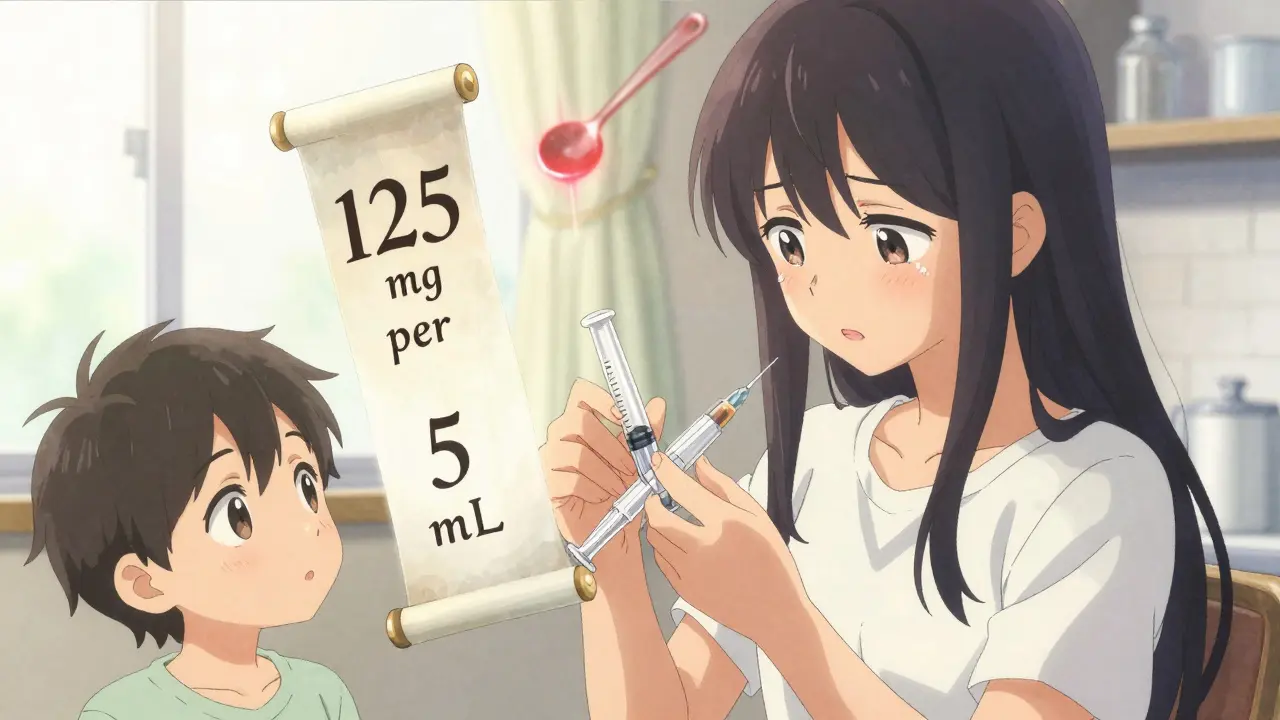
When a label says "take two tablets every 6 hours," it seems simple. But it’s not. People often misunderstand what "every 6 hours" means. It doesn’t mean four times a day. It means every 6 hours while awake. So if you wake up at 7 a.m., take it at 1 p.m., 7 p.m., and 1 a.m. That’s three doses. Taking it four times means you’re overdosing.For liquid medicines, it gets trickier. Labels list concentration: "125 mg per 5 mL." That means each teaspoon (5 mL) has 125 mg of medicine. If your child needs 250 mg, you need two teaspoons-not "a little more than one." Many parents guess. That’s how overdoses happen.
One study found that 68% of parents made mistakes when measuring liquid medicine for their kids. Why? They used kitchen spoons. A teaspoon from your drawer can hold anywhere from 2.5 mL to 7.3 mL. That’s a 200% difference. The American Academy of Pediatrics says: never use kitchen spoons. Always use the oral syringe or dosing cup that came with the medicine. If it didn’t come with one, ask the pharmacist for one. They’re free.
Why Warnings Are More Important Than You Think
A 2021 survey showed that 47% of people never read the warnings section. That’s terrifying. Warnings aren’t legal fine print. They’re survival instructions.For example, if you’re on blood thinners like warfarin, and you take ibuprofen, you could start bleeding internally. That warning is on the ibuprofen bottle. If you’re diabetic and take a cold medicine with sugar or alcohol, your blood sugar could crash. That’s in the warnings too.
Another big one: "Do not take with alcohol." This isn’t just about getting drunk. Mixing alcohol with painkillers like acetaminophen can cause liver failure. With sedatives or antidepressants, it can stop your breathing. The label says it plainly. You just have to read it.
And don’t ignore warnings about driving or operating machinery. Many common medicines-antihistamines, muscle relaxers, even some antidepressants-can make you drowsy. You might feel fine, but your reaction time is slowed. That’s why truck drivers and nurses are told to check labels before work.
What to Do When You’re Confused
If you don’t understand a label, don’t guess. Don’t ask a friend. Don’t Google it. Go to the pharmacist. Pharmacists are trained to explain labels. They see hundreds of these mistakes every week.Here’s what to say: "I’m not sure how to take this. Can you walk me through the directions?" Ask them to point out the active ingredient and the dose. Ask: "Is this safe with my other meds?" They’ll check for interactions.
Some medicines come with extra guides-called Medication Guides. These are required for high-risk drugs like opioids, insulin, or chemotherapy. If you didn’t get one, ask for it. It’s your right.
And if you’re caring for an elderly parent or a child, write down the instructions. Use big letters. Tape the label to the fridge. Set phone alarms for doses. Don’t rely on memory. Even smart people forget.
What’s Changing in Medication Labels
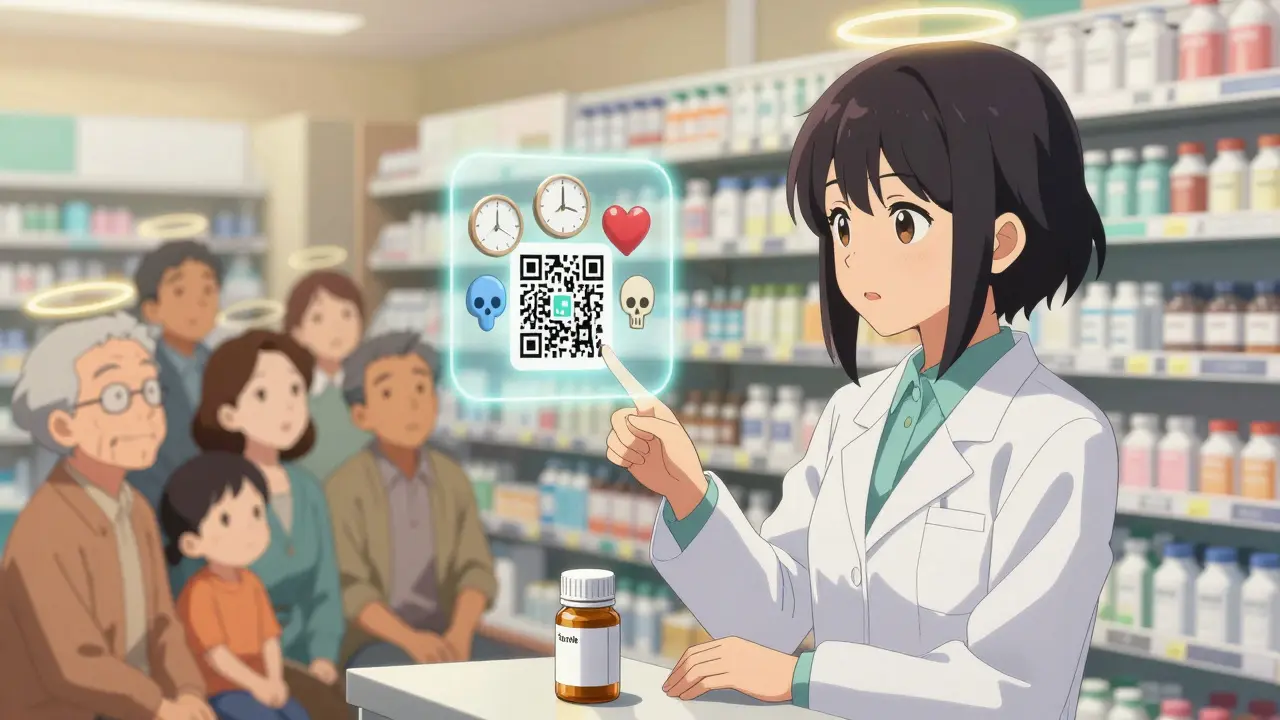
The system isn’t perfect. In 2022, the FDA found that 78% of patients want simpler language and pictures on labels. So change is coming.By 2024, many prescription bottles will have QR codes. Scan it with your phone, and you’ll get a video showing how to take the medicine. Some will even have interactive calculators that tell you the right dose based on your weight or age.
Also, high-alert drugs-like insulin, blood thinners, and opioids-will soon have standardized color-coding. Red might mean "high risk," blue might mean "take with food." Icons will be universal: a skull for toxicity, a clock for timing, a heart for cardiac risks.
This isn’t science fiction. Pilot programs in hospitals cut medication errors by 37%. That’s thousands of lives saved each year. The goal is to make labels so clear, even someone with low literacy or limited English can understand them.
Five Steps to Read Any Label Correctly
Follow this simple checklist every time you get a new medicine:- Check your name. Is it spelled right? Wrong name = wrong medicine.
- Find the active ingredient. Write it down. Then check all your other meds. No duplicates.
- Read the dose. Is it in mg, mL, or tablets? Don’t guess. Use the tool that came with it.
- Scan the warnings. Look for "do not use," "avoid alcohol," or "consult doctor if."
- Write it down. Even if you think you’ll remember. Put it on your phone calendar with a reminder.
Do this every time. Even if you’ve taken the same medicine before. Manufacturers change formulas. Pharmacies switch suppliers. The label might be different now.
What Happens When You Skip the Label
A 2022 report from the Cleveland Clinic found that 27% of emergency room visits for medication errors happened because people took too much of the same ingredient. One patient took three different cold medicines-all with acetaminophen. He didn’t know. His liver failed. He needed a transplant.Another case: a woman took a sleep aid with alcohol because the label didn’t say "avoid alcohol" clearly enough. She stopped breathing. She survived, but barely.
These aren’t rare. They’re routine. And they’re preventable. The label is your last line of defense. If you don’t read it, you’re gambling with your health.
Final Reminder: Labels Don’t Change-You Do
Your body changes. Your weight changes. Your other meds change. Your liver or kidneys might not work as well as they used to. That means the same dose that was safe last year might be dangerous now.Every time you refill a prescription, check the label again. Even if it’s the same drug. Even if you’ve taken it for years. The pharmacy might have switched brands. The concentration might be different. The warnings might have been updated.
Medication safety isn’t about being perfect. It’s about being careful. One extra minute reading the label can save your life-or someone else’s.

Madhav Malhotra
January 12, 2026 AT 06:33Man, I never thought about how many of us just grab meds like snacks. In India, we often share pills with family ‘cause it’s ‘the same thing’-but wow, this post laid it out so clearly. I’m gonna start reading labels like a detective now. Thanks for the wake-up call! 😊
Christian Basel
January 12, 2026 AT 18:29The FDA’s Drug Facts format is a regulatory artifact designed to satisfy compliance overhead, not to enhance patient comprehension. The structural homogenization of OTC labeling creates a cognitive burden through redundancy and linguistic noise-especially when non-pharmacists are expected to parse pharmacokinetic implications from bullet points. It’s not user-centered design; it’s liability mitigation dressed as education.
Roshan Joy
January 13, 2026 AT 07:22Really appreciate this breakdown. I used to think ‘every 6 hours’ meant 4x a day too-until my niece got sick and the pharmacist corrected me. Now I always ask for the dosing cup. And yeah, those QR codes? Genius. My mom can’t read small print, but she can scan a video. Simple, smart, lifesaving. 👍
Sean Feng
January 14, 2026 AT 01:36People are dumb and lazy and this is why they die
Adewumi Gbotemi
January 14, 2026 AT 18:18Back home in Nigeria, we often get medicine from markets without labels. Sometimes the only thing on the bottle is a color. I’m glad you’re pushing for clearer labels-it could save so many lives where education is scarce. Simple pictures and big words? Yes please.
Priya Patel
January 15, 2026 AT 10:29OMG I just realized I’ve been using a kitchen spoon for my kid’s amoxicillin for TWO YEARS 😱 I’m running to the pharmacy right now for a syringe. This post just saved my baby. Thank you thank you thank you!! 🙏💖
Alfred Schmidt
January 16, 2026 AT 05:22Why are we still letting corporations design medicine labels?! This is a public health crisis engineered by profit-driven systems! The FDA’s ‘Drug Facts’ is a joke-look at how they bury warnings in tiny font while making ‘Uses’ bold and shiny! It’s psychological manipulation disguised as transparency! And don’t even get me started on the $10,000 pill bottles with QR codes while people starve! This isn’t safety-it’s performative compliance!
Priscilla Kraft
January 17, 2026 AT 21:33Love that you mentioned pharmacists! They’re the unsung heroes of medication safety. I always ask mine to explain the label-especially if I’m on multiple meds. They’ve caught interactions my doctor missed. And yes, ask for the Medication Guide! It’s free, it’s detailed, and it’s written for humans, not lawyers. 🙌❤️
Vincent Clarizio
January 18, 2026 AT 08:27Think about it: the entire paradigm of pharmaceutical consumption is built on the assumption that the individual is a rational, literate, and cognitively intact agent capable of parsing dense regulatory text under conditions of pain, fatigue, anxiety, or cognitive fog-conditions often induced by the very medication being consumed. We are asking the sick to be their own pharmacists while the system offloads liability onto the patient’s attention span. The label is not a manual-it’s a test. And we’ve failed the test not because people are stupid, but because the system was never designed for human frailty. The QR codes, the color-coding, the icons-they’re not innovations, they’re apologies. And they’re long overdue. We are not failing the label. The label is failing us.