Post-Market Drug Interactions: Why Safety Risks Appear After Approval
 Apr, 29 2026
You’ve probably heard the phrase "clinical trials" when a new medication is announced. It sounds like a guarantee of safety, but here is the reality: trials are just the first step. The true test of a drug happens when it hits the real world, where millions of people with different genetics, diets, and existing health problems start taking it. This is where drug safety monitoring is the ongoing process of detecting, assessing, and preventing adverse effects of medicines after they have been approved for public use.
When a drug interaction is discovered "post-market," it means a dangerous reaction between two medicines-or a medicine and a food-wasn't caught during the trial phase. This isn't necessarily because the scientists missed something obvious, but because clinical trials have built-in blind spots. For most of us, this means the medication we've taken for years might suddenly get a new "black box warning" or be pulled from the shelves entirely. Understanding why this happens helps us become more proactive about our own health.
The Gap Between Clinical Trials and Real Life
Why do these risks show up only after a drug is approved? It comes down to numbers and diversity. A typical pre-market trial usually involves between 1,000 and 5,000 participants. While that sounds like a lot, it's a drop in the bucket compared to the millions of people who might eventually use the drug. Moreover, these trials often exclude the very people most likely to experience interactions: the elderly, children, and people with multiple chronic illnesses (comorbidities).
Trials are also short-usually lasting 6 to 12 months. But many drug interactions only manifest after years of chronic use. For instance, the risk of valvular heart disease linked to the drug benfluorex wasn't spotted until about 5 million patients had used it over three decades. By the time the danger was clear, the drug had been on the market for 30 years before its 2009 withdrawal in France.
Essentially, pre-market trials catch about 50-60% of common reactions. The remaining 40-50%-including the most serious ones-are often only found through Post-marketing Surveillance (PMS), which monitors the drug's behavior in the general population.
Three Ways Drugs Interact Post-Market
Not all interactions are the same. Most post-market discoveries fall into one of three buckets:
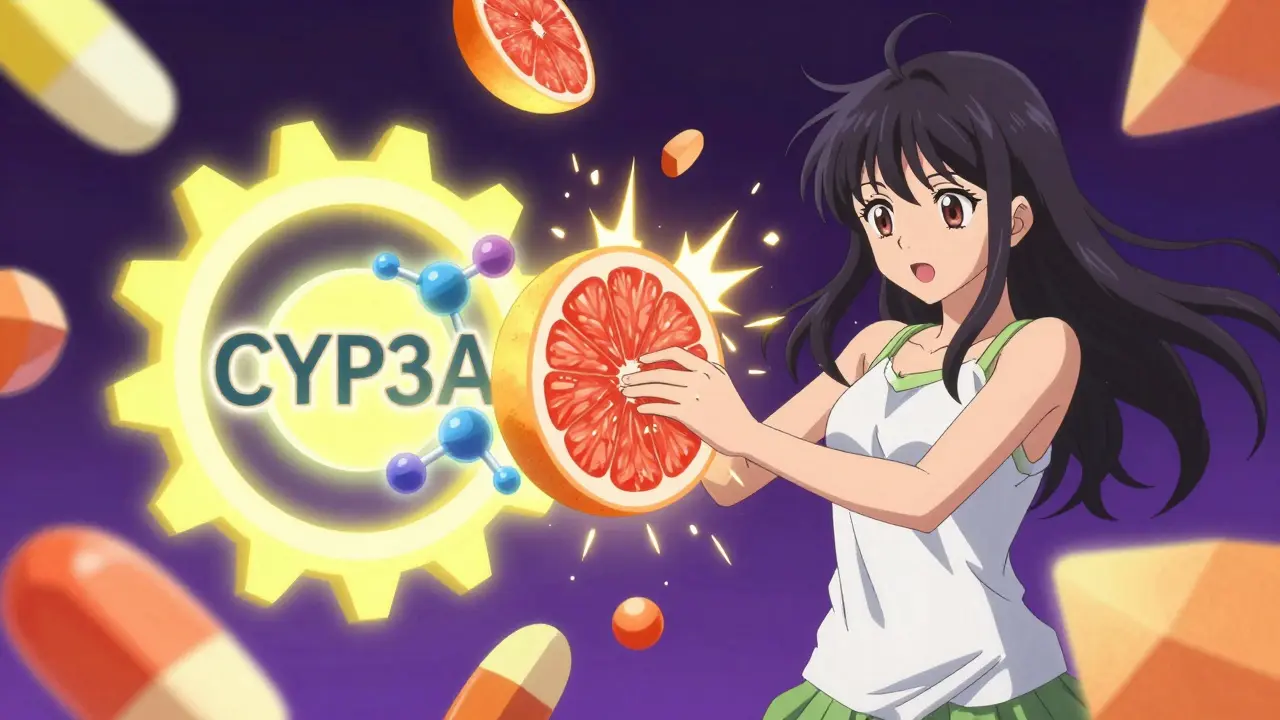
- Drug-Drug Interactions: This happens when one medication changes how another works. A classic, dangerous example is the combination of the antifungal drug fluconazole and the cholesterol medication simvastatin. Fluconazole blocks the CYP3A4 enzyme, which the body needs to break down simvastatin. This causes the statin levels in the blood to spike 3 to 10 times higher than normal, which can lead to rhabdomyolysis-a severe breakdown of muscle tissue that can permanently damage the kidneys.
- Drug-Condition Interactions: This is when a pre-existing health issue makes a drug dangerous, or a drug makes a health condition worse. These are harder to spot in trials because participants are often screened to be "relatively healthy" to avoid complicating the data.
- Drug-Food Interactions: Your diet can act like a second medication. Take grapefruit juice, for example. It blocks the same CYP3A4 enzymes mentioned above. If you're taking atorvastatin (Lipitor), grapefruit juice can increase the drug's concentration in your system by up to 15-fold, significantly raising the risk of toxic side effects.
| Feature | Pre-Market Clinical Trials | Post-Marketing Surveillance |
|---|---|---|
| Population Size | 1,000 - 5,000 people | Millions of users |
| Duration | Short-term (6-12 months) | Long-term (Years/Decades) |
| Patient Diversity | Highly screened/Limited | Real-world (all ages/illnesses) |
| Detection Rate | ~50-60% of common reactions | 70-80% of serious reactions |
How the Authorities Track These Risks
Since we can't predict every interaction, regulators use massive databases to spot patterns. In the US, the FDA Adverse Event Reporting System (FAERS) acts as an early warning system. When a doctor or patient reports a side effect, it goes into this system. If a pattern emerges-like a spike in kidney failure reports among patients taking both a statin and an antifungal-the FDA investigates.
The FDA's Sentinel Initiative takes this a step further by proactively monitoring over 300 million patient records across various data partners. Instead of waiting for a report to be filed, they can search the data for "signals" of danger. Across the Atlantic, the European Medicines Agency uses the EudraVigilance system, which now uses AI to recognize patterns in millions of reports, cutting the time it takes to detect a safety signal from 18 months down to just 45 days.
However, the system isn't perfect. Experts estimate that 90-95% of adverse events are never reported to the FDA. This "underreporting gap" means that some dangerous interactions persist for years before they are officially recognized.
What Happens When a New Interaction is Found?
Once a risk is confirmed, the regulator doesn't always pull the drug. Instead, they use a tiered response based on how dangerous the interaction is:
- Labeling Updates: The most common outcome. The manufacturer adds a warning to the package insert.
- Black Box Warnings: The most serious warning. A literal black box is placed on the label to alert doctors and patients to a risk of permanent injury or death. About 20% of new medications eventually receive one of these post-market.
- Safety Communications: The FDA issues a public alert to healthcare providers to stop prescribing a certain combination of drugs.
- Market Withdrawal: If the risk outweighs the benefit, the drug is pulled. A famous example is terfenadine (Seldane), which was withdrawn after it was found that taking it with ketoconazole could cause fatal heart rhythm problems.
Protecting Yourself from Undiscovered Risks
Since the system relies on reports and patterns, there is always a chance you're taking a combination that hasn't been flagged yet. How do you stay safe? First, keep a complete, updated list of everything you take-including herbal supplements like St. John's Wort. We've seen cases, such as with the blood thinner apixaban, where St. John's Wort caused life-threatening bleeding because the interaction wasn't highlighted enough in early labels.
Second, don't rely solely on one person. Your doctor knows your medical history, but your pharmacist is often the real expert on drug chemistry. They have access to interaction checkers and the latest safety alerts. If you're starting a new medication, ask your pharmacist: "Does this interfere with anything else I'm taking, including my vitamins or diet?"
Finally, be aware of "dose dumping." This occurs when a medication designed for slow release is suddenly released all at once. For example, the drug Exalgo was found to cause this when combined with alcohol, leading to accidental overdoses. This was only discovered 18 months after it hit the market.
Why aren't all drug interactions found during clinical trials?
Clinical trials have limited sample sizes (usually 1,000 to 5,000 people) and short durations. They often exclude elderly patients or people with multiple diseases, meaning rare or long-term interactions only appear when millions of diverse people start using the drug in the real world.
What is a "black box warning"?
A black box warning is the strictest warning assigned by the FDA. It is placed on a drug's labeling to alert prescribers and patients about serious or life-threatening risks associated with the medication, often discovered through post-marketing surveillance.
How can I check if my medications have an interaction?
The most reliable way is to consult your pharmacist, who uses professional databases. You can also use reputable interaction checkers like GoodRx or the FDA's updated labeling, but these should supplement-not replace-professional medical advice.
Do herbal supplements cause post-market interactions?
Yes. Many supplements are not regulated as strictly as drugs, but they can still interact. For example, St. John's Wort is well-known for interfering with the metabolism of various medications, including blood thinners and antidepressants.
What should I do if I suspect a medication is causing a side effect?
Contact your doctor immediately to discuss symptoms. You can also report the event directly to the FDA via the MedWatch system, which helps other patients by adding your experience to the post-marketing surveillance data.

Allison Maier
April 30, 2026 AT 15:27Basically saying drugs are risky. Wow, what a shocker 🙄
Kelly Feehely
May 2, 2026 AT 03:19This is exactly why you can't trust these "trials"! They keep the real data hidden until they have to admit it because people are dying. It is all about the profit margins and the FDA is just a rubber stamp for big pharma. They don't care if you have a "drug-food interaction" as long as the checks clear. Wake up people, they are using us as lab rats in a giant experiment and then just slapping a black box on the label when the body count gets too high to ignore. It is absolutely disgusting how they treat human lives like disposable variables in a spreadsheet!
Joel Bonstell
May 2, 2026 AT 16:33I totaly get why this is scarry. Just remember to keep a list of everythng you take on your phone, it makes it so much easier for the doc to see what is going on and avoid those bad mixes. Hope everyon stays safe out there!
Elizabeth Holden
May 3, 2026 AT 13:02Lol’d at the grapefruit thing. Everone knows about grapefuit, it’s like basic stuff. The way they write this makes it sound like some big secret but it’s just common sense to read the label before you pop a pill. honestly just lazy if you dont know this already 🙄
Kartik Agarwal
May 3, 2026 AT 18:12The pharmacovigilance framework described here is essential. From a systemic perspective, the transition from controlled clinical environments to heterogeneous real-world populations introduces countless variables in cytochrome P450 metabolism, specifically the CYP3A4 isoform mentioned. Integrating AI-driven signal detection within the EudraVigilance system allows for the identification of rare adverse drug reactions (ADRs) that would otherwise remain statistically insignificant in smaller cohorts. This is a critical evolution in maintaining a positive benefit-risk ratio for patients globally.
Jimmy Crocker
May 5, 2026 AT 11:36One simply cannot ignore the inherent flaws in the metodology of these trials, as the sample sizes are laughably inadequate for the complexities of human biology, yet the general public continues to swallow these findings without a shred of critical analysis regarding the long-term efficacy and safety profils. It is truly an exercise in mediocrity when the regulatory bodies rely on underreporting, which is practically a design feature of the system, rather than implementing a more robust, mandatory reporting structure that would actually hold these corporations accountable for their negligence.
Alexa Mack
May 6, 2026 AT 09:27It's really interesting how different countries handle this. I wonder if there are places where they prioritize the long-term monitoring even more than the initial approval phase. It feels like a bit of a gamble, but seeing the AI tools mentioned makes me feel a bit better about the future of safety.
princess lovearies
May 6, 2026 AT 22:50Just take a deep breath and trust your gut. If something feels off with your meds, speak up. We all have to navigate this complex system together and supporting each other is the best way to stay healthy.