PCSK9 Inhibitors vs Statins: Side Effects and Outcomes
 Mar, 8 2026
Cholesterol Reduction Calculator
Your Current Situation
Expected Outcomes
Reduction: (compared to current level)
Treatment Options
When it comes to lowering cholesterol, two types of drugs dominate the conversation: statins and PCSK9 inhibitors. Both work to reduce LDL (bad) cholesterol, but they’re fundamentally different in how they work, what side effects they cause, and who they’re best for. If you’ve been told your cholesterol is too high and you’re weighing your options, understanding the real differences between these two can make all the difference in your health outcomes.
How Statins Work - and Why So Many People Take Them
Statins have been the go-to cholesterol drug for nearly 40 years. The first one, lovastatin, hit the market in 1987. Since then, they’ve become the most prescribed medication in the U.S., with about 40 million people taking them as of late 2023. They work by blocking an enzyme in the liver called HMG-CoA reductase. That enzyme is what your body uses to make cholesterol. When it’s slowed down, your liver produces less cholesterol, and your blood LDL levels drop.
At standard doses, statins typically lower LDL by 30% to 50%. High-dose versions like atorvastatin (Lipitor) or rosuvastatin (Crestor) can push that number higher, especially in people with heart disease. That’s why guidelines from the American Heart Association and American College of Cardiology still recommend statins as the first-line treatment for most people with high cholesterol or cardiovascular risk.
But statins aren’t perfect. About 5% to 10% of people experience muscle pain or weakness - a condition called statin-associated myopathy. Some report memory fog or fatigue. On Drugs.com, 32% of negative reviews mention persistent muscle pain, and 18% talk about mental fuzziness. These aren’t rare side effects - they’re common enough that doctors routinely screen for them.
Another concern is liver enzyme changes. While serious liver damage is rare, doctors still check liver function tests early on. And here’s something many don’t know: statins slightly raise the risk of hemorrhagic stroke in certain people - especially those with a history of bleeding in the brain. UCLA research from 2023 found a 22% increased risk (95% CI 1.05-1.42) in high-risk groups.
How PCSK9 Inhibitors Work - The New Kid on the Block
PCSK9 inhibitors - like alirocumab (Praluent) and evolocumab (Repatha) - came on the scene in 2015. Unlike statins, they don’t touch cholesterol production. Instead, they block a protein called PCSK9. That protein normally tells your liver to destroy LDL receptors. When you block PCSK9, those receptors stick around longer and pull more LDL out of your blood.
The result? A dramatic drop in LDL. In clinical trials, PCSK9 inhibitors lower LDL by 50% to 61%. That’s significantly more than even high-dose statins. In the ODYSSEY trial, alirocumab cut LDL by 61%. In the FOURIER trial, evolocumab brought it down by 59%. When you combine a PCSK9 inhibitor with a statin, you can knock LDL down by up to 75% - something no single oral drug can do.
They’re given as a simple subcutaneous injection - either every two weeks or once a month. No pills. No daily routine. Just a small needle, usually in the thigh, abdomen, or upper arm. Most people learn to self-inject after one or two sessions. The ODYSSEY COMFORT trial showed 85% of patients got comfortable with it within three tries.
Side Effects: What You Won’t Get With PCSK9 Inhibitors
This is where PCSK9 inhibitors really stand out: they avoid the most common statin side effects.
No muscle pain? Check. In studies and real-world reports, only about 2% of PCSK9 inhibitor users report muscle issues - far lower than the 5-10% with statins. On Drugs.com, 79% of users say they don’t have muscle pain anymore after switching. That’s huge for people who had to stop statins because of discomfort.
No liver enzyme spikes? Also true. PCSK9 inhibitors aren’t processed by the liver’s CYP450 system like statins are. They don’t interfere with other medications or cause liver stress. That makes them safer for people on multiple drugs or with liver conditions.
And here’s another win: no increased stroke risk. Multiple trials, including a 2024 meta-analysis in Frontiers in Cardiovascular Medicine, found no link between PCSK9 inhibitors and hemorrhagic stroke. For someone with a history of brain bleeds or high blood pressure, this matters.
So what are the downsides? Injection site reactions - redness, swelling, or itching - happen in about 5% of users. Not serious, but annoying. Then there’s the cost. A year of PCSK9 inhibitors used to cost $14,000. Now, thanks to price cuts and insurance changes, it’s closer to $5,000-$7,000. Still, that’s 500 times more than generic statins, which cost $4-$10 a month.

Who Gets Prescribed PCSK9 Inhibitors - And Why
PCSK9 inhibitors aren’t for everyone. They’re reserved for specific cases:
- People with statin intolerance - If you tried two or more statins and had muscle pain, liver issues, or other side effects, this is your path.
- Familial hypercholesterolemia - A genetic condition where LDL is sky-high from birth. One patient in the FH Foundation registry dropped from 286 mg/dL on rosuvastatin to 58 mg/dL after adding alirocumab.
- Very high-risk ASCVD patients - If you’ve had a heart attack, stroke, or have diabetes plus heart disease, and your LDL is still above 70 mg/dL on max statin therapy, guidelines say you’re a candidate.
Insurance companies know this. In the U.S., 87% require proof that you’ve tried and failed on at least two statins before approving a PCSK9 inhibitor. That means paperwork, prior authorizations, and sometimes appeals. Manufacturer support programs (like Amgen’s Repatha SupportPlus) help with that - 92% of users say they found them “very helpful.”
Effectiveness Beyond LDL: What Statins Do That PCSK9 Inhibitors Don’t
It’s not all about LDL numbers. Statins have what’s called “pleiotropic effects.” That’s fancy talk for benefits beyond cholesterol lowering. They reduce inflammation in artery walls. They stabilize plaque so it’s less likely to rupture and cause a heart attack. Some studies suggest they even improve endothelial function and reduce clotting risk.
PCSK9 inhibitors don’t do this. They’re very focused: lower LDL. And they do it well. But long-term data shows statins reduce heart attacks, strokes, and death from cardiovascular disease by 25-35% over 5-10 years. PCSK9 inhibitors show similar reductions - around 27% fewer events over two years in the JAMA Cardiology study by Nicholls et al. - but we don’t yet have 10-year mortality data.
That’s why experts like Dr. Paul Ridker from Harvard still say: “Statins remain the foundation.” They’re proven. They’re cheap. They’ve saved millions of lives. PCSK9 inhibitors are an upgrade - not a replacement.
Cost vs. Benefit: The Hard Truth
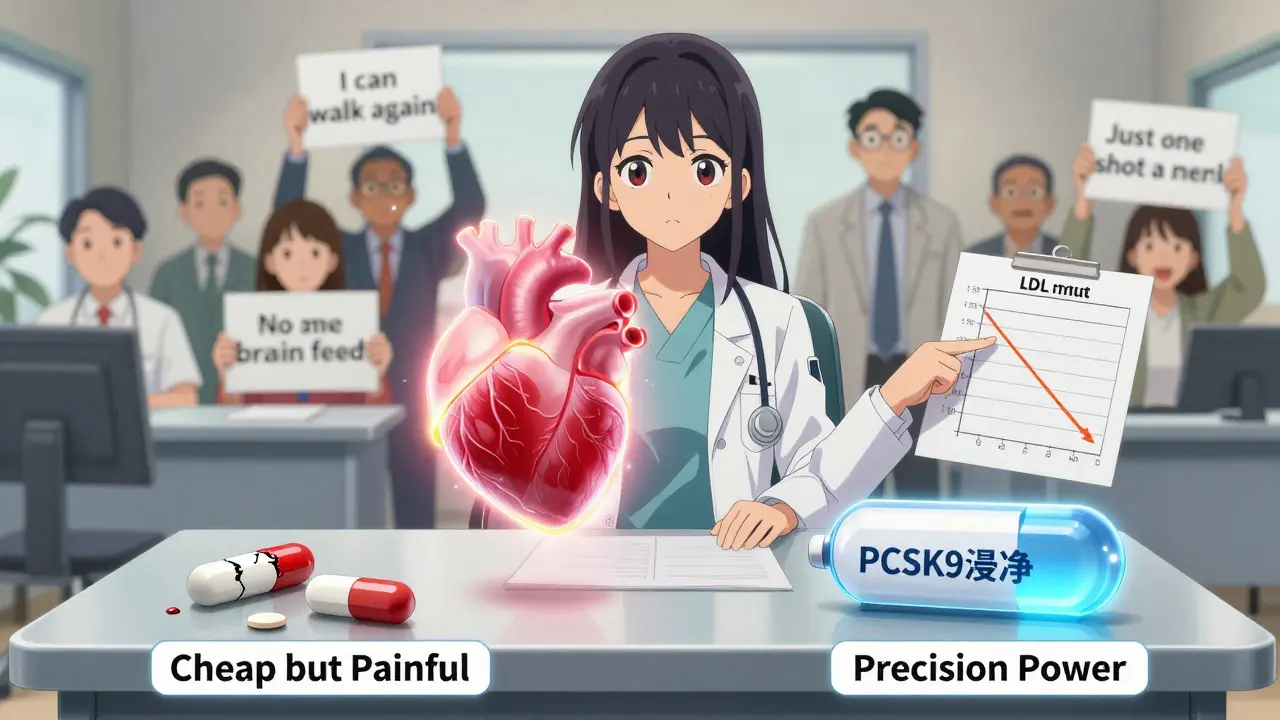
Let’s be real. You can’t ignore cost. A generic statin like simvastatin costs $4 a month. A PCSK9 inhibitor? $400-$600 a month after insurance. That’s $5,000-$7,000 a year. The 2024 Frontiers cost analysis found PCSK9 inhibitor + statin therapy costs 3.2 times more than statin + ezetimibe.
But here’s the twist: for high-risk patients, the cost may be worth it. A 2024 study in the Journal of the American College of Cardiology found that for people with very high-risk ASCVD, PCSK9 inhibitors cost about $45,000 per quality-adjusted life year (QALY) gained. That’s within the accepted range for cost-effective care in the U.S. ($50,000-$150,000/QALY).
And prices are falling. In 2024, manufacturers cut prices by up to 60%. Some insurers now cover them with low copays if you meet strict criteria. If you’re in that group - high risk, failed statins - the barrier is less about money and more about getting the paperwork right.
What’s Next? The Future of Cholesterol Drugs
PCSK9 inhibitors aren’t the end of the story. In 2021, the FDA approved inclisiran (Leqvio), a twice-yearly injection that silences the PCSK9 gene. It’s not a daily or biweekly shot - it’s two shots a year. Early data shows it lowers LDL by 50% with long-term safety.
Even more exciting? Oral PCSK9 inhibitors are in Phase II trials. Merck’s MK-0616, tested in mid-2024, lowered LDL by 60% in a 12-week trial. If approved, this could be a game-changer - no needles, no injections, just a pill.
By 2028, experts predict PCSK9 inhibitor prescriptions will jump from 1.2 million to 3.5 million annually. That’s not because statins are failing - it’s because we now have better tools for the toughest cases.
Real People, Real Stories
Reddit threads tell the human side. In r/cholesterol, one user wrote: “Switched from atorvastatin to evolocumab after 10 years of statin myopathy - life-changing.” It had 147 upvotes. Another said, “My LDL dropped from 190 to 48 in 3 months. No pain. No fatigue. Just peace of mind.”
But not everyone wins. On r/healthinsurance, people post screenshots of denied claims. “Insurance said I didn’t have ‘documented intolerance’ - but I couldn’t walk up stairs on simvastatin.”
Success stories happen when the right person gets the right drug. It’s not about which one is “better.” It’s about which one works for you.
Are PCSK9 inhibitors safer than statins?
Yes, for certain side effects. PCSK9 inhibitors don’t cause muscle pain, liver enzyme spikes, or increased stroke risk like statins can. They’re generally safer for people who can’t tolerate statins or have a history of brain bleeds. But they’re not risk-free - injection site reactions and rare allergic responses can occur.
Can I take a PCSK9 inhibitor instead of a statin?
Not usually. Guidelines recommend statins as first-line therapy because they’re proven, affordable, and reduce overall mortality. PCSK9 inhibitors are reserved for people who can’t reach LDL targets on statins, or who can’t tolerate them. In rare cases - like familial hypercholesterolemia - a PCSK9 inhibitor may be used alone, but that’s decided by a specialist.
Do PCSK9 inhibitors work better than high-dose statins?
For LDL reduction, yes. PCSK9 inhibitors lower LDL by 50-61%, while even high-dose statins max out at 50%. But statins reduce heart attacks and death over the long term. PCSK9 inhibitors show strong short-term benefits, but we’re still waiting for 10-year outcome data. Combining both can lower LDL by 75% - which is why many high-risk patients use them together.
Why are PCSK9 inhibitors so expensive?
They’re biologic drugs - made from living cells, not chemicals. That makes them harder and costlier to produce than statins. When they launched in 2015, they cost $14,000 a year. Since then, manufacturers cut prices by up to 60%, and insurance coverage has improved. Still, they’re far more expensive than statins, which cost $4-$10 a month as generics.
What if I can’t afford PCSK9 inhibitors?
Talk to your doctor about alternatives. Ezetimibe (Zetia) lowers LDL by 15-20% and costs under $20/month. Bempedoic acid (Nexletol) is another option - an oral pill that works differently and costs less than PCSK9 inhibitors. Also, manufacturer assistance programs can reduce out-of-pocket costs to under $50/month for eligible patients. Don’t give up - there are options.
If you’re struggling with statin side effects or your cholesterol still won’t budge, talk to your doctor about whether a PCSK9 inhibitor might be right for you. It’s not a magic bullet, but for the right person, it can be life-changing.

Leon Hallal
March 8, 2026 AT 20:32Statins wrecked my legs for years. No amount of stretching helped. Switched to evolocumab and suddenly I could climb stairs without wincing. No magic, just science that actually works for some of us.
Judith Manzano
March 10, 2026 AT 02:59I love how this breaks down the real trade-offs. Most people think it's statins or nothing, but there's a whole middle ground. The fact that PCSK9 inhibitors don't touch liver enzymes is huge for people on multiple meds. Finally, a treatment that doesn't add new problems.
rafeq khlo
March 11, 2026 AT 13:06The data presented here is statistically significant yet emotionally manipulated. One must consider the pharmaceutical incentives behind PCSK9 promotion. The industry has shifted from treating disease to monetizing biomarkers. LDL is not a disease it is a measurement. The true pathology lies in systemic inflammation not a single lipid fraction.
Tom Sanders
March 13, 2026 AT 10:41So basically statins make you feel like crap but work. PCSK9 inhibitors don't make you feel crap but cost a fortune. Guess I'll just keep eating donuts and hoping for the best.
Jazminn Jones
March 15, 2026 AT 03:26It is astonishing how casually the public accepts biologics as superior without understanding their pharmacokinetic profile. The notion that a monoclonal antibody is inherently better than a small molecule inhibitor is a fallacy perpetuated by marketing departments. The 27% event reduction over two years does not equate to long-term mortality benefit. This is not medicine it is spectacle.
Stephen Rudd
March 16, 2026 AT 06:17Statins are a scam. The whole cholesterol theory is based on flawed 1970s data. They're pushing PCSK9 inhibitors because they know statins are failing people. I've seen too many patients with muscle necrosis. This isn't healthcare it's a profit machine. The FDA is compromised. The NIH is compromised. The whole system is rigged.
Erica Santos
March 18, 2026 AT 02:30Oh so now we're supposed to be impressed because a drug costs $5000 a year and doesn't make you feel like a zombie? Congratulations we've upgraded from a $4 pill to a $600 monthly injection. The real innovation here is how well Big Pharma milks the desperation of people who can't afford to be healthy.
George Vou
March 19, 2026 AT 00:42they say statins cause muscle pain but what if its just your body telling you to stop eating sugar and get off the couch? i think the whole cholesterol thing is a distraction. they want you hooked on pills so you keep paying. i stopped statins and my energy came back. no injection needed. just food and sleep.
Scott Easterling
March 19, 2026 AT 18:09Wait wait wait. You're telling me this $7000/year drug doesn't cause liver damage? That's impossible. I read on a forum that all injectables are just slow poison. The body can't handle foreign proteins. They're putting antibodies in your veins. That's not medicine. That's science fiction. And the fact that they're pushing this over statins? It's all about the money. They don't care if you live or die. They just want your insurance card.
Mantooth Lehto
March 20, 2026 AT 03:04I switched to alirocumab after 8 years of statin hell. My legs stopped aching. My brain stopped fogging. I can finally sleep through the night. I cried the first time I walked up the stairs without pain. This isn't just a drug. It's a second chance. And yeah it's expensive. But what's the cost of never being able to play with your kids again?
Melba Miller
March 21, 2026 AT 08:01Why are we even having this conversation? In America you get treated based on your zip code not your health. The guy in Beverly Hills gets the $7000 drug. The guy in Detroit gets the generic and told to "just eat better." That's not a medical decision. That's a class war. And the fact that we're debating whether this drug works when the real issue is access? We're all just rearranging deck chairs on the Titanic.