NSAIDs and Peptic Ulcer Disease: Understanding the Risk of Gastrointestinal Bleeding
 Dec, 29 2025
NSAID Risk Assessment Tool
Find out your risk of NSAID-related bleeding
This assessment is based on the American College of Gastroenterology's risk scoring system. Results help you understand if you're in a high-risk group for gastrointestinal bleeding when taking NSAIDs.
Enter your information to see your risk score
Every year, millions of people take NSAIDs for back pain, arthritis, or a bad headache. But for many, these common painkillers come with a silent danger: gastrointestinal bleeding. It doesn’t always come with sharp pain or vomiting blood. Sometimes, it’s just fatigue, pale skin, or iron deficiency anemia that shows up months later. And by then, it’s too late to ignore.
How NSAIDs Cause Ulcers and Bleeding
NSAIDs like ibuprofen, naproxen, and diclofenac work by blocking enzymes called COX-1 and COX-2. COX-2 causes inflammation and pain, so blocking it helps. But COX-1 protects your stomach lining by making mucus and keeping blood flowing to the gut. When NSAIDs shut down COX-1, your stomach loses its natural defense. That’s when acid starts eating away at the lining, creating erosions, ulcers, and sometimes deep, bleeding sores.It’s not just prescription NSAIDs. Over-the-counter versions are just as risky. A 2021 review found that 26% of people take OTC NSAIDs at doses higher than recommended-and most never tell their doctor. That’s a problem because bleeding doesn’t wait for a prescription. It can happen after just a few days of use, especially in older adults.
Who’s at Highest Risk?
Not everyone who takes NSAIDs gets bleeding. But some people are far more likely to. The American College of Gastroenterology uses a simple scoring system to spot them:- Age over 70: +2 points
- History of peptic ulcer or bleeding: +2 points
- Taking blood thinners like warfarin or aspirin: +2 points
- Using corticosteroids (like prednisone): +1 point
If your score is 2 or higher, you’re in the high-risk group. Studies show people in this group are up to four times more likely to bleed than someone with no risk factors. And it’s not just age or past ulcers. Taking more than one NSAID at a time, or mixing them with alcohol, makes things worse. One 2017 study found that people using multiple NSAIDs had a 1.9 times higher risk of bleeding.
COX-2 Inhibitors: Safer for the Stomach, Riskier for the Heart
Celecoxib and other COX-2 inhibitors were designed to avoid the stomach damage caused by traditional NSAIDs. They spare COX-1, so they don’t strip away the stomach’s protective layer. A 2000 Lancet study showed celecoxib caused 50% fewer serious ulcers than ibuprofen.But there’s a trade-off. The 2004 APPROVe trial found rofecoxib (Vioxx) doubled the risk of heart attack. That drug was pulled off the market. Celecoxib carries a lower risk, but the FDA still requires a black box warning about cardiovascular events. So while COX-2 inhibitors are gentler on the gut, they’re not a free pass. They’re best for people with high stomach risk but low heart risk.
PPIs: The Real Game-Changer
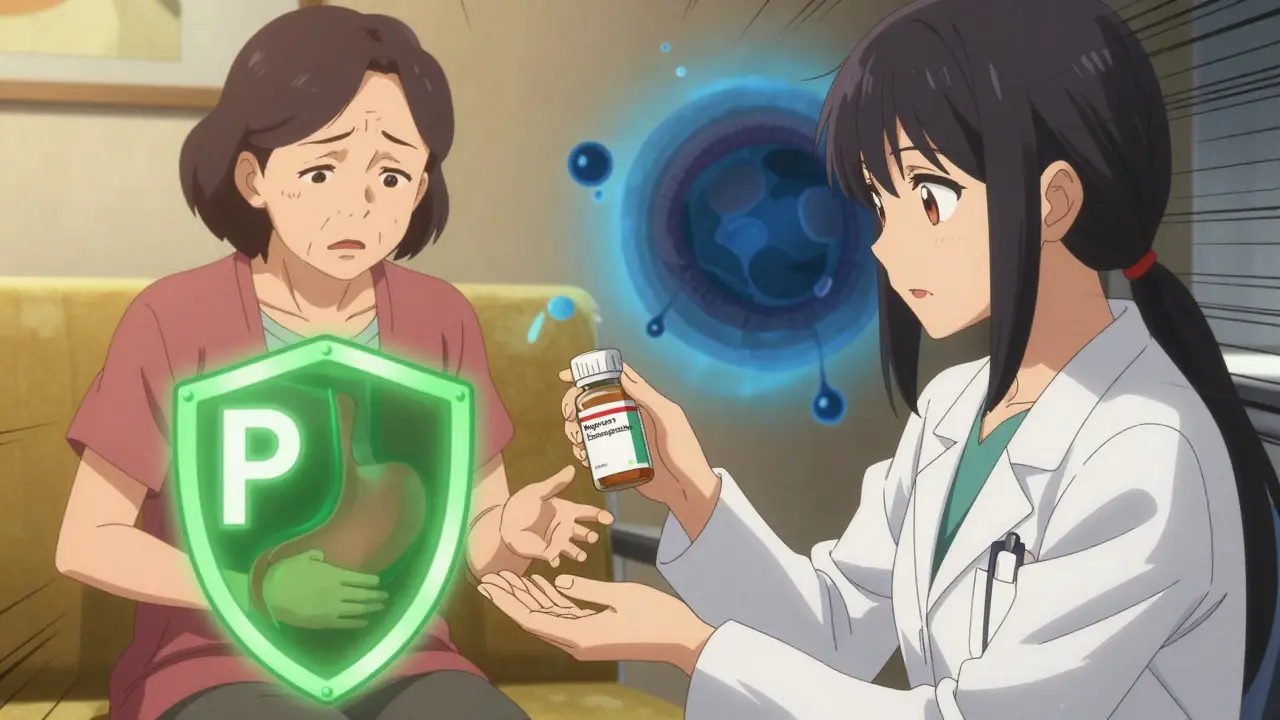
If you need to take an NSAID and you’re at risk, proton pump inhibitors (PPIs) like omeprazole or esomeprazole are your best defense. A 2017 Cochrane review of over 13,000 patients found that PPIs cut the risk of NSAID-related ulcers and bleeding by 75%. That’s not a small improvement-it’s life-saving.Here’s what works best: Start the PPI before you start the NSAID. Don’t wait for symptoms. If you’re 75 with a history of ulcers and you’re prescribed naproxen, take omeprazole from day one. A 2022 trial showed that combining naproxen with esomeprazole (Vimovo) reduced ulcer complications from 25.6% to just 7.3%. That’s a 72% drop.
Misoprostol is another option-it reduces ulcer risk by 50-75%-but it causes diarrhea in up to 20% of users and isn’t safe during pregnancy. Most doctors avoid it unless there’s no other choice.
The Hidden Bleeding: It’s Not Always Obvious
Most people think bleeding means black, tarry stools or vomiting blood. But that’s only half the story. Many NSAID-related bleeds are slow and hidden. They don’t cause pain. They just steal iron from your blood over weeks or months. You feel tired. Your nails get brittle. Your doctor finds low hemoglobin-and you didn’t even realize you were bleeding.One Reddit user shared how their 78-year-old mother ended up in the hospital needing three blood transfusions. She’d been taking ibuprofen daily for knee pain. No stomach pain. No vomiting. Just weakness. A colonoscopy found multiple small bowel ulcers. She’d never told her doctor about the NSAIDs.
That’s why it’s so important to talk to your doctor-even if you think it’s just “a little painkiller.” A 2022 survey by the Arthritis Foundation found that 42% of people stopped taking NSAIDs because of GI symptoms… but only 37% ever told their doctor about them.

What Should You Do?
If you’re taking NSAIDs regularly, here’s what to do:- Ask yourself: Do I have any risk factors? Age over 65? Past ulcer? On blood thinners? Taking steroids?
- If yes: Talk to your doctor about switching to a COX-2 inhibitor with a PPI-or using the lowest dose for the shortest time.
- If no: Still, don’t take NSAIDs daily without checking in. Use them for acute pain, not long-term management.
- Watch for signs: Fatigue, dizziness, dark stools, unexplained anemia. Don’t assume it’s just aging.
- Never mix NSAIDs: Don’t take ibuprofen and naproxen together. Don’t take OTC NSAIDs with aspirin for heart protection unless your doctor says so.
For people with arthritis or chronic pain, alternatives like physical therapy, weight management, or acetaminophen (Tylenol) may be safer. Acetaminophen doesn’t hurt the stomach lining. It’s not as strong for inflammation, but it’s much safer for long-term use.
The Bigger Picture
NSAIDs cause about 107,000 hospitalizations and 16,500 deaths in the U.S. every year. That’s more than car accidents. And the cost? Over $2.2 billion annually. These aren’t rare side effects. They’re predictable, preventable, and often ignored.Pharmaceutical companies know this. That’s why they developed combo pills like Vimovo-naproxen and esomeprazole in one tablet. It’s not cheap, but for high-risk patients, it’s worth it. The Institute for Clinical and Economic Review found that naproxen with PPI costs just $12,500 per quality-adjusted life year saved. Celecoxib with PPI? $45,200. That’s a big difference.
Future drugs are coming. New compounds called CINODs-like naproxcinod-combine NSAID action with nitric oxide, which helps protect the gut. Early trials show 50% fewer ulcers than naproxen alone. But they’re still in testing.
For now, the safest path is simple: Know your risk. Talk to your doctor. Don’t assume NSAIDs are harmless. And if you’re taking them long-term, ask about a PPI. It’s not about avoiding pain relief. It’s about protecting your body while you get it.
Can I take ibuprofen if I’ve had a stomach ulcer before?
If you’ve had a peptic ulcer or GI bleeding before, you should avoid NSAIDs like ibuprofen unless absolutely necessary. If you must take one, your doctor will likely prescribe a COX-2 inhibitor like celecoxib along with a proton pump inhibitor (PPI) like omeprazole. This combination reduces the risk of another bleed by up to 80%. Never restart NSAIDs without medical advice.
Are over-the-counter NSAIDs safer than prescription ones?
No. OTC NSAIDs like ibuprofen and naproxen carry the same risks as prescription versions. The difference is dose and duration. Many people take OTC NSAIDs daily for months without realizing the danger. The risk of bleeding increases with higher doses and longer use-even at OTC levels. Always follow the label, and don’t use them for more than 10 days without checking with a doctor.
Do all NSAIDs cause the same level of stomach damage?
No. Non-selective NSAIDs like naproxen and diclofenac are more likely to cause ulcers and bleeding because they block both COX-1 and COX-2. Selective COX-2 inhibitors like celecoxib are much gentler on the stomach-but not risk-free. Ibuprofen at low doses (200-400 mg/day) carries a slightly lower risk than naproxen, but still higher than no NSAID at all. Always assume any NSAID can harm your gut.
Can I take aspirin with NSAIDs?
Taking aspirin with other NSAIDs increases your risk of bleeding. Aspirin itself is an NSAID and irritates the stomach lining. If you’re on low-dose aspirin for heart protection, avoid other NSAIDs if possible. If you need pain relief, acetaminophen is safer. If you must use an NSAID, your doctor may recommend a PPI to reduce the risk. Never combine NSAIDs with aspirin without medical supervision.
How do I know if I’m bleeding internally from NSAIDs?
Internal bleeding from NSAIDs often has no pain or obvious symptoms. Signs include unexplained fatigue, pale skin, shortness of breath, dizziness, or dark, tarry stools. Blood tests may show low hemoglobin or iron deficiency anemia. If you’ve been taking NSAIDs regularly and feel unusually tired, ask your doctor for a blood test. Don’t wait for vomiting blood-that’s a late sign.
Is there a safer alternative to NSAIDs for chronic pain?
Yes. Acetaminophen (Tylenol) is the safest oral option for pain relief without stomach risks. For inflammation, non-drug options like physical therapy, weight loss, heat/cold therapy, or topical capsaicin can help. In some cases, duloxetine or pregabalin may be prescribed for nerve-related pain. Always discuss alternatives with your doctor before assuming NSAIDs are your only choice.

Fabian Riewe
December 30, 2025 AT 16:00Been taking naproxen for my back for years. Never knew it could silently wreck my gut until my hemoglobin dropped to 8.5. Got on omeprazole and life’s better. Don’t wait for black stools - fatigue is the real red flag.
Tamar Dunlop
December 30, 2025 AT 18:00As someone who has witnessed a loved one nearly lose their life to a silent GI bleed, I am compelled to say this with the utmost gravity: NSAIDs are not harmless. They are silent predators in medicine cabinet disguise. The statistics are not abstract - they are mothers, fathers, grandparents, and friends. Please, for the love of all that is tender in this world, speak to your physician before the next pill.
David Chase
December 31, 2025 AT 17:38OMG I CAN’T BELIEVE PEOPLE STILL DON’T KNOW THIS!!! 🤯 NSAIDs AREN’T CANDY!! I’ve seen so many dumbasses pop ibuprofen like M&Ms like it’s 2005 and we’re all invincible. 🚨 107K HOSPITALIZATIONS?! That’s more than gun violence in some states!! 😡 And don’t even get me started on OTC ‘just a little’ doses - it’s a lie. The FDA is asleep at the wheel. #NSAIDSAFETY
Emma Duquemin
January 1, 2026 AT 02:33Y’all, I used to be the person who thought ‘if it’s on the shelf, it’s safe.’ Spoiler: it’s not. I started taking celecoxib + omeprazole after my third endoscopy showed ‘erosive gastritis.’ Now I’m pain-free AND my stomach isn’t a warzone. 🙌 Pro tip: Ask for Vimovo - it’s a game-changer. Also, try turmeric + fish oil for inflammation. Not magic, but way gentler. Your gut will thank you.
Kevin Lopez
January 2, 2026 AT 01:10COX-1 inhibition → reduced prostaglandin E2 → diminished mucosal defense → gastric acid erosion. PPIs upregulate H+/K+ ATPase suppression. Evidence: Cochrane 2017, RR 0.25 (95% CI 0.19–0.34). Risk stratification: ACG score ≥2 = high risk. No ambiguity. Stop self-prescribing.
Duncan Careless
January 2, 2026 AT 23:16My dad took ibuprofen for 8 years for arthritis. Never complained of stomach pain. One day he collapsed. Turned out he’d been bleeding internally for 11 months. They found 4 ulcers. He’s fine now, thanks to PPIs and a wake-up call. If you’re on NSAIDs long-term, please, just ask your doctor about a PPI. It’s not a big ask. It could save your life.
Samar Khan
January 3, 2026 AT 19:33LOL imagine being so dumb you think OTC means safe 😂 I’m from India and we’ve been using diclofenac gel + oral combo since the 90s. Half the people I know have ulcers. But hey, at least they’re not dead yet 🤷♀️ #NSAIDSWILLKILLYOU
Russell Thomas
January 4, 2026 AT 13:32Oh wow, so NSAIDs are dangerous? Shocking. Next you’ll tell me oxygen can kill you if you breathe it too long. 🙄 Get a grip. People have been taking Advil since 1984 and we’re still here. Your ‘silent bleeding’ is just a scare tactic to sell more PPIs. My grandma takes naproxen daily and she’s 92. She’s fine. You’re overreacting.
Paige Shipe
January 5, 2026 AT 16:12While I appreciate the clinical depth of this post, I must note that the emphasis on PPIs may be misleading. Long-term PPI use is associated with increased risk of C. diff, bone fractures, and micronutrient deficiencies. The risk-benefit analysis is not as straightforward as implied. A more balanced approach - including non-pharmacological interventions and staggered NSAID use - should be prioritized. The data on CINODs is promising but underreported.
Nicole K.
January 6, 2026 AT 04:09If you’re taking NSAIDs without a PPI, you’re basically playing Russian roulette with your insides. You’re not brave, you’re just stupid. Stop being lazy and get your act together. Your stomach isn’t a trash can.
Joe Kwon
January 6, 2026 AT 13:01Just want to add: if you’re on low-dose aspirin for cardiac protection, you’re already at higher risk. Adding any other NSAID? That’s stacking the deck. I’ve seen patients on aspirin + naproxen + prednisone - triple threat. Always go with acetaminophen first. If it doesn’t work, then talk to your doc about COX-2 + PPI. No shame in safety.