Monitoring During Immunosuppressive Therapy: Lab Tests and Imaging
 Feb, 11 2026
Immunosuppressive Therapy Monitoring Calculator
Get personalized recommendations for blood tests and imaging based on your transplant type, medications, and time since transplant.
Your Personalized Monitoring Plan
When someone receives a kidney, liver, or heart transplant-or is treated for severe autoimmune diseases like lupus or rheumatoid arthritis-they’re given drugs that quiet down their immune system. These are called immunosuppressants. They work. But they don’t come with a manual. Too little, and the body attacks the new organ. Too much, and the patient gets sick from infections, kidney damage, or even cancer. That’s why monitoring isn’t optional-it’s life-saving.
Why Monitoring Isn’t Just a Routine Check
Immunosuppressants like tacrolimus, cyclosporine, and mycophenolate don’t behave the same way in every person. Two patients on the same dose can have blood levels that differ by tenfold. One might feel fine. The other could be on the edge of rejection or toxicity. This is why fixed doses don’t work. You can’t guess what’s happening inside someone’s body. You need data.
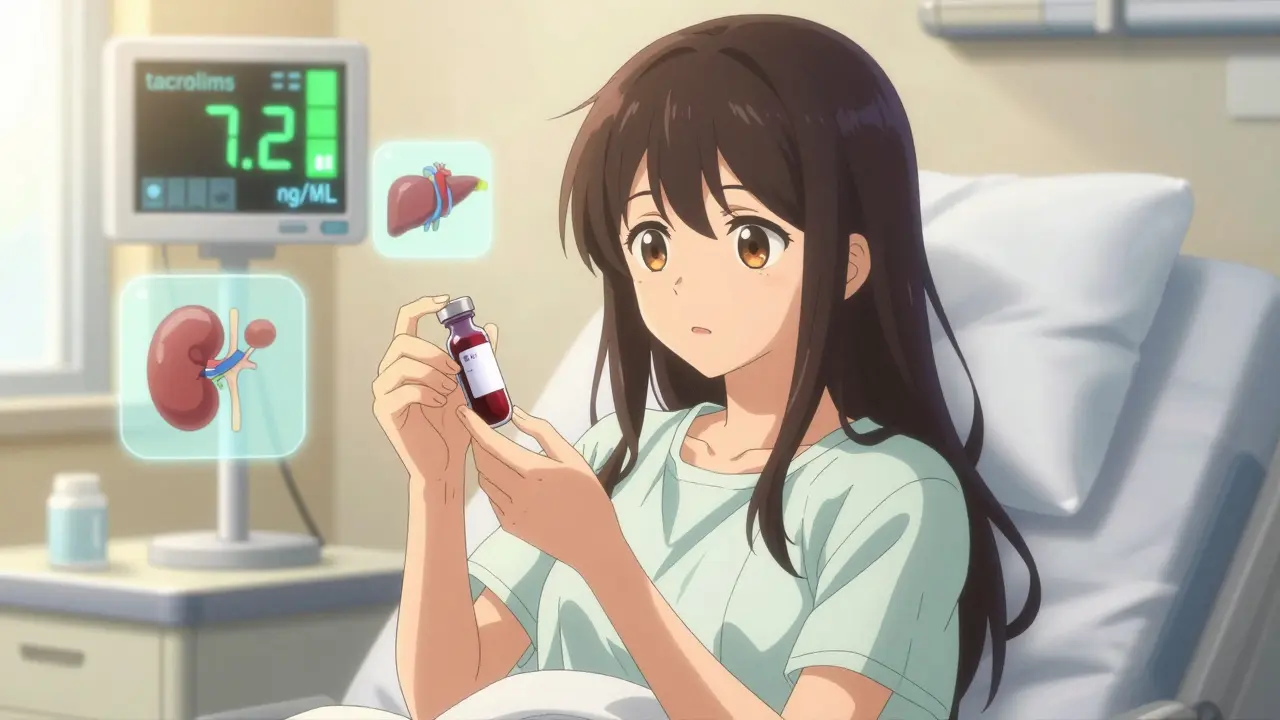
Therapeutic drug monitoring (TDM) is the backbone of this process. It means regularly measuring how much of the drug is in the bloodstream. For tacrolimus, the target range is 5-10 ng/mL in the first three months after transplant, then lowered to 3-7 ng/mL. For cyclosporine, it’s 100-200 ng/mL. But here’s the catch: these numbers aren’t magic. They’re starting points. Real-time adjustments are made based on how the patient responds.
Not all drugs need this level of tracking. Steroids like prednisone? No routine blood test needed. Belatacept? Also not monitored. But calcineurin inhibitors and mTOR blockers? Absolutely. That’s because their therapeutic window is razor-thin-sometimes just a 2- to 4-fold difference between what works and what harms.
How Labs Track Drug Levels
There are two main ways labs measure these drugs: immunoassays and liquid chromatography-tandem mass spectrometry (LC-MS/MS). Immunoassays are cheaper-$50 to $100 per test-but they can’t always tell the difference between the active drug and its inactive metabolites. That leads to false readings, sometimes off by 15-20%. LC-MS/MS is the gold standard. It’s precise, accurate, and detects only the real drug. But it costs $150-$250 per test. Most transplant centers use LC-MS/MS for tacrolimus and cyclosporine because the stakes are too high to risk error.
For mycophenolic acid (MPA), trough levels aren’t enough. Because MPA gets recycled through the gut and liver, what matters is the total exposure over time-the area under the curve (AUC). Studies show that keeping AUC between 30-60 mg·h/L cuts rejection risk to just 15% in the first year. If you only check the lowest point in the cycle, you might miss the fact that the patient had a dangerous spike earlier.
Blood Tests Beyond the Drug
Monitoring isn’t just about the drug. It’s about what the drug does to your body. Every 1-3 months, patients get a full panel: complete blood count, kidney and liver function, electrolytes, glucose, and lipids. Why? Because each drug has its own signature of side effects.
- Tacrolimus: Can cause new-onset diabetes in up to 30% of patients. Fasting glucose is checked at every visit.
- Cyclosporine: Leads to high creatinine (kidney strain) and low magnesium. Magnesium levels are checked monthly. If they drop below 1.5 mg/dL, supplementation is started.
- Sirolimus: Raises cholesterol and triglycerides in 60-75% of patients. Lipid panels are done every six months. If LDL hits above 160 mg/dL, statins are added.
- Mycophenolate: Causes low white blood cells, low platelets, and diarrhea. If the white count falls below 3.0 x10⁹/L, the dose is reduced.
These aren’t just lab values. They’re warning signs. A creatinine jump of 30% from baseline? That’s a red flag for kidney damage. A platelet count below 100 x10⁹/L? That’s a signal to hold the drug and investigate.
Imaging: What You Can’t See in Blood
Some problems don’t show up in a blood test. That’s where imaging comes in.
- Renal ultrasound: Done annually or whenever kidney function changes. It checks for blockages, fluid buildup, or reduced blood flow to the transplanted organ. A kidney that looks shrunken or scarred? That’s chronic damage.
- Chest X-ray: If a patient has a cough, fever, or low oxygen, a chest X-ray screens for pneumonitis-especially with sirolimus. This drug can inflame lung tissue. Sensitivity is 70-85%, so if it looks normal but symptoms persist, a CT scan follows.
- Bone density scan (DEXA): Steroids weaken bones. After one year of treatment, patients get a baseline scan. If T-score is below -2.5, they’re diagnosed with osteoporosis and start bisphosphonates or calcium/vitamin D.
These aren’t fancy extras. They’re essential tools. A patient might feel fine, but an ultrasound could reveal early signs of rejection before they even have symptoms.
The New Frontier: TTV Monitoring
There’s a quiet virus in your body called Torque Teno Virus (TTV). It doesn’t cause disease. But in transplant patients, it’s become a powerful indicator of immune strength. The more suppressed your immune system, the more TTV multiplies.
Research shows TTV levels correlate strongly with drug concentration. When TTV is below 2.5 log₁₀ copies/mL, rejection risk doubles. Above 3.5 log₁₀, infection risk spikes. A 2023 trial called TTVguideIT found that using TTV to guide dosing cut infections by 28% and rejections by 22% compared to standard monitoring.
This isn’t science fiction. It’s happening now. In Australia, Canada, and parts of Europe, TTV testing is being rolled out in transplant centers. The goal? To personalize therapy-not just by drug level, but by immune function. One patient might need a higher dose because their TTV is low. Another might safely drop their dose because their TTV is high. It’s the first time we’ve had a real-time window into immune activity, not just drug concentration.

What’s Holding Back Better Monitoring?
Even with all the science, real-world practice is messy. A 2022 survey of 150 transplant centers found that 68% had no consistent protocol across departments. Some units use LC-MS/MS. Others still use cheaper, less accurate tests. Only 42% monitor MPA properly. Why? Cost, lack of training, and no standardized guidelines.
Patients pay the price. They get 12-18 blood draws in the first year. Many report anxiety, bruising, and fatigue. One woman in Auckland said, “I dread my Friday morning clinic. I know I’ll get poked, and I’ll wait two days for results that might mean I have to change my whole life.”
Centers that do it right have dedicated teams-pharmacists, nurses, and nephrologists-who review every result within 24 hours. They adjust doses before problems start. They call patients directly if something’s off. That’s the difference between just monitoring and truly managing.
What’s Coming Next
The future is fast. AI algorithms are already predicting rejection 14 days before it happens by combining tacrolimus levels, TTV load, and creatinine trends. Accuracy? 87%. Point-of-care devices that can give drug levels in 10 minutes are in phase 2 trials. By 2026-2027, a patient might get their tacrolimus result before leaving the clinic.
Even more exciting: non-invasive monitoring. Researchers are testing exhaled breath for metabolites of immunosuppressants. If it works, blood draws could become rare. Imagine a simple breath test every month instead of a needle every week.
The cost-benefit is clear. Comprehensive monitoring adds $2,850 per patient per year-but prevents $8,400 in hospital costs from rejection and infection. That’s a nearly 3:1 return. For a system stretched thin, this isn’t just smart. It’s necessary.
What Patients Should Know
If you’re on immunosuppressants, you’re not just taking pills. You’re part of a data-driven system. Keep your appointments. Don’t skip blood tests. Ask: “What are we looking for today?” and “What will we do if the numbers are off?”
Know your drug targets. Understand your side effects. If you’re on sirolimus and your cholesterol is high, don’t wait. Ask about statins. If your white count drops, don’t assume it’s normal. Push for a dose review.
And if your center doesn’t use TTV or LC-MS/MS-ask why. The tools exist. The evidence is strong. You deserve the best monitoring available.
Do all immunosuppressants need blood monitoring?
No. Only drugs with a narrow therapeutic index need regular blood level checks. This includes tacrolimus, cyclosporine, sirolimus, and mycophenolate. Steroids like prednisone and belatacept do not require routine therapeutic drug monitoring because their effects are more predictable and less dependent on precise blood concentrations.
How often should lab tests be done after a transplant?
In the first three months, most patients have blood tests every 1-2 weeks. From months 4-6, testing drops to every 2-4 weeks. After six months, if everything is stable, most labs are done monthly. Lipid panels and bone density scans are done every six months and annually, respectively. Frequency increases if there’s a change in kidney function, infection, or drug side effects.
Is TTV monitoring available everywhere?
Not yet. TTV monitoring is still emerging and is primarily used in major transplant centers in North America, Europe, and Australia. It’s not FDA-approved for routine use as of early 2026, but many centers use it under research protocols. Standardized assays are still being developed, and cut-off values vary between labs. Widespread adoption is expected after 2026, following results from the TTVguideIT trial.
Why is LC-MS/MS better than immunoassays for drug monitoring?
LC-MS/MS (liquid chromatography-tandem mass spectrometry) can distinguish the active drug from its metabolites, giving a true measure of the therapeutic compound. Immunoassays sometimes mistake inactive breakdown products for the active drug, leading to overestimation of levels by 15-20%. This can cause doctors to reduce the dose unnecessarily, increasing rejection risk. LC-MS/MS is more accurate, with precision of 95-98%, but costs more.
Can I avoid frequent blood tests if I feel fine?
Feeling fine doesn’t mean your body is fine. Immunosuppressant toxicity and rejection often happen without symptoms until they’re advanced. A creatinine level that’s 20% above baseline might mean early kidney damage. A low white count might mean you’re at risk for a serious infection. Skipping tests increases the chance of organ loss, hospitalization, or death. Monitoring isn’t about discomfort-it’s about prevention.
Monitoring during immunosuppressive therapy is no longer a one-size-fits-all checklist. It’s a dynamic, personalized system built on science, data, and constant adjustment. The goal isn’t just to keep the drug in range-it’s to keep the patient alive, healthy, and thriving for decades.

Annie Joyce
February 11, 2026 AT 17:10Alyssa Williams
February 13, 2026 AT 04:23Stephon Devereux
February 13, 2026 AT 19:43Robert Petersen
February 15, 2026 AT 02:11Jack Havard
February 16, 2026 AT 20:03Neha Motiwala
February 17, 2026 AT 11:29Annie Joyce
February 19, 2026 AT 05:32Steve DESTIVELLE
February 20, 2026 AT 14:54steve sunio
February 22, 2026 AT 14:06Craig Staszak
February 23, 2026 AT 20:02alex clo
February 25, 2026 AT 01:16