Medication Cost Sharing: Deductibles, Copays, and Coinsurance Explained
 Jun, 13 2026
You pick up your prescription at the pharmacy counter. The total is $450. You hand over your insurance card, expecting to pay a small fee. Instead, the pharmacist tells you it’s going to be $380. Or maybe $90. Or perhaps just $15. Why does the price swing so wildly from one visit to the next? It isn’t random pricing or a glitch in the system. It’s cost sharing.
Understanding how your health plan splits the bill for medications is the difference between budgeting effectively and getting hit with a surprise that wrecks your monthly finances. Most people know they have insurance, but few understand the specific mechanics of deductibles, copays, and coinsurance-especially when it comes to prescriptions. Let’s break down exactly what you are paying for, when you pay it, and how to stop guessing at the checkout counter.
What Is Cost Sharing in Health Insurance?
Cost sharing is simply the portion of healthcare expenses that you pay directly, rather than having your insurance cover the full amount. This concept emerged strongly during the evolution of managed care in the United States and was standardized by the Affordable Care Act (ACA) of 2010. The ACA required clear definitions for these terms so that every plan sold on the marketplace had to include them.
The goal of cost sharing is balance. Insurance companies use these mechanisms to keep monthly premiums lower while ensuring that members share some financial responsibility for their care. According to Blue Cross Blue Shield of Michigan, this shared model helps control healthcare utilization. If everything were free at the point of service, premiums would skyrocket. By making you pay a part of the cost, insurers encourage you to think about whether a service-or a medication-is truly necessary.
However, not all costs count as "cost sharing." Your monthly premium, for example, is not cost sharing. Neither are penalties or the cost of services your plan doesn't cover at all. As defined by the Centers for Medicare & Medicaid Services (CMS), cost sharing is strictly "your share of costs for services that a plan covers that you must pay out of your own pocket."
Deductibles: The Threshold Before Coverage Kicks In
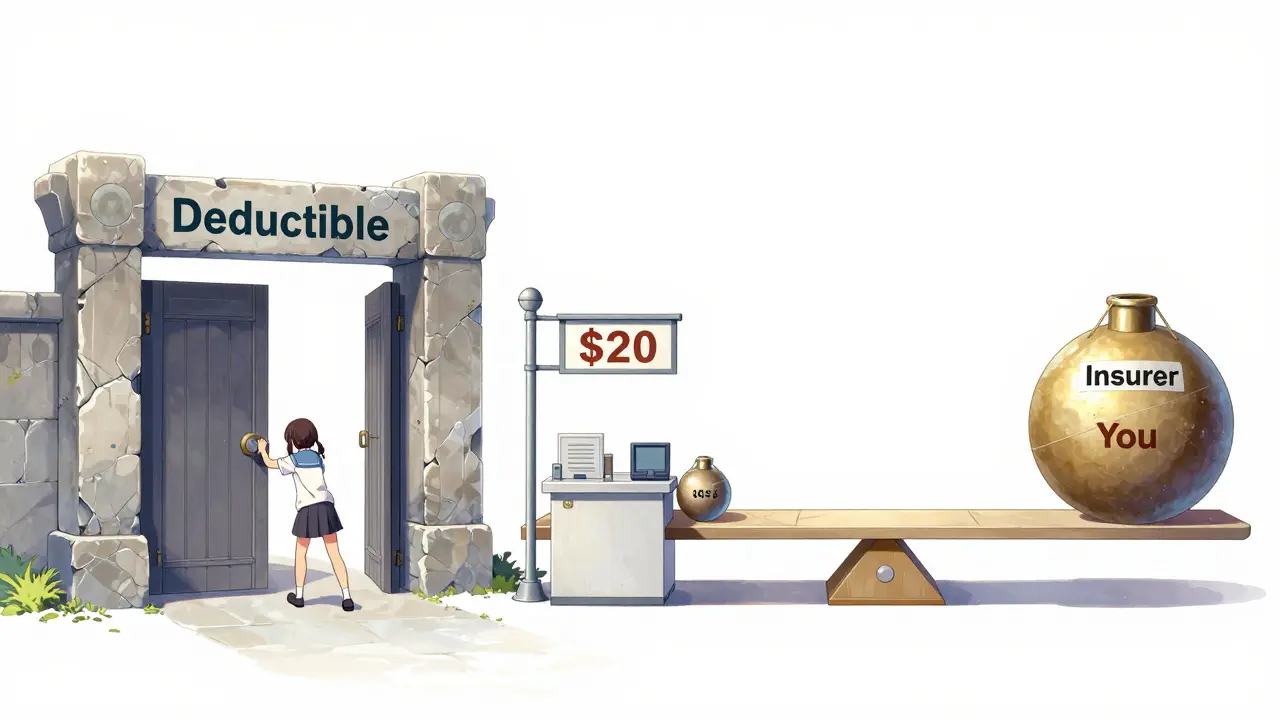
Think of your deductible as a gate. You have to walk through it entirely on your own dime before your insurance company starts helping you pay. If your plan has a $1,500 deductible, you pay 100% of eligible medical and prescription expenses until those bills add up to $1,500.
For medications, this can be tricky. Many plans apply prescription costs toward your deductible, but some high-deductible health plans (HDHPs) paired with Health Savings Accounts (HSAs) have strict IRS rules. In these cases, you often cannot get any discount or copay on drugs until you have met that full deductible amount. This means if you need a $200 medication in January and your deductible is $1,500, you pay the full $200. That payment counts toward your $1,500 goal, but you get no immediate relief from the insurer.
There is one major exception mandated by the ACA: preventive care. Annual checkups and certain preventive screenings are usually covered at no cost to you, even before you meet your deductible. Unfortunately, most routine maintenance medications do not fall under this "preventive" umbrella unless specifically designated by your plan.
Copays: The Fixed Price Tag
If deductibles are gates, copays are toll booths with a set price. A copayment (or copay) is a fixed dollar amount you pay at the time of service. For primary care visits, this might be $25. For specialist visits, it could be $50. For prescriptions, it varies by tier.
Most insurance plans divide medications into tiers:
- Tier 1: Generic drugs. These usually have the lowest copay, often ranging from $5 to $15.
- Tier 2: Brand-name drugs with generic alternatives. Copays here might range from $30 to $60.
- Tier 3: Specialty brand-name drugs. These often have higher copays or may shift to coinsurance.
The beauty of a copay is predictability. You know exactly what you will pay before you fill the script. However, not all plans use copays for everything. Some plans eliminate copays entirely after you meet your deductible, switching instead to coinsurance. Others use a hybrid approach where generics have a flat copay, but specialty drugs use a percentage-based cost share.
Coinsurance: Paying a Percentage
Coinsurance is different from a copay because it is not a fixed number. It is a split. After you have met your deductible, you and your insurer agree to split the remaining costs based on a percentage. A common split is 80/20, meaning the insurer pays 80% and you pay 20%.
Let’s look at a concrete example from Healthy Children. Imagine you need a procedure or a specialized medication that costs $850. Your plan has an 80/20 coinsurance structure. You don’t pay $850. You don’t pay a flat $30. You calculate 20% of $850, which is $170. You pay $170, and the insurance company pays the remaining $680.
This becomes critical for expensive medications. If you are taking a biologic drug for arthritis or a multiple sclerosis treatment that costs thousands of dollars per month, a 20% coinsurance can still result in hundreds of dollars in out-of-pocket costs per fill. Unlike a copay, which caps your liability for that specific visit, coinsurance scales with the price of the drug. The more expensive the medication, the more you pay.
The Safety Net: Out-of-Pocket Maximums
No matter how high your deductible or coinsurance goes, there is a hard cap on what you will pay in a year. This is your out-of-pocket maximum (OOPM). Once you hit this limit, your insurance pays 100% of covered services for the rest of the calendar year.
For 2023, the ACA mandated that individual OOPMs could not exceed $9,100, and family OOPMs could not exceed $18,200. These numbers adjust slightly each year for inflation. It is crucial to remember that only cost-sharing amounts count toward this maximum. Your monthly premiums do not count. Only deductibles, copays, and coinsurance payments contribute to reaching this safety net.
Knowing your OOPM is vital for financial planning. If you have a chronic condition requiring expensive meds, you might reach your OOPM by July. From August to December, your medications should theoretically be free (assuming they are covered and in-network). Tracking these payments helps you anticipate when the financial pressure will lift.
Comparing Cost-Sharing Mechanisms
| Element | How It Works | When It Applies | Impact on Budget |
|---|---|---|---|
| Deductible | Fixed dollar amount you pay first | Before insurance shares costs | High initial burden; resets yearly |
| Copay | Fixed fee per prescription/visit | At time of service (often regardless of deductible) | Predictable; low variability |
| Coinsurance | Percentage of the total cost | After deductible is met | Variable; scales with drug price |
| Out-of-Pocket Max | Cap on total annual spending | End of coverage cycle | Safety net; prevents catastrophic debt |

Why Confusion Leads to Surprise Bills
A survey by Healthcare.gov found that 68% of consumers are confused about how deductibles and out-of-pocket maximums differ. Worse, 42% mistakenly believe their out-of-pocket maximum includes their premium payments. This misunderstanding leads to shock when the year ends and the bill hasn’t stopped coming.
Another major source of confusion is network status. If you go to an out-of-network pharmacy, your plan may still share the cost, but your coinsurance percentage will be much higher, or the service may not count toward your OOPM at all. The No Surprises Act, implemented in 2022, protects against unexpected emergency charges, but it does not fully shield you from choosing an out-of-network provider for non-emergency needs like routine prescriptions.
According to the Patient Advocate Foundation, 31% of patients with chronic conditions experienced unexpected medical bills due to misunderstanding how coinsurance applied to specialty medications. Always verify if your preferred pharmacy is in-network and ask about the formulary tier of your medication before you fill it.
Strategies to Manage Medication Costs
You can’t change the structure of your insurance plan mid-year, but you can navigate it smarter. Here are practical steps to reduce your financial strain:
- Use Cost Estimators: Research shows consumers who use their insurer’s online cost estimator tools save an average of 22% on out-of-pocket expenses. Check the estimated price before you go to the pharmacy.
- Review the Summary of Benefits: Insurers must provide a standardized document showing how deductibles, copays, and coinsurance apply to common scenarios. Read it. Look for the section on "Prescription Drugs."">
- Ask About Generics: If you are on a Tier 2 or 3 brand-name drug, ask your doctor if a generic equivalent exists. Moving from a $50 copay to a $10 copay adds up significantly over a year.
- Track Your Spending: Keep a running tally of your deductibles and OOPM contributions. Apps from your insurer or third-party trackers can help you see when you are close to hitting your maximum.
- Utilize Patient Assistance Programs: For high-cost specialty drugs, manufacturers often offer programs that lower coinsurance or provide free samples. Don’t assume you have to pay the full sticker price.
The Future of Cost Sharing
The landscape is shifting. High-deductible health plans now cover 43% of insured workers, up from just 4% in 2006. This trend pushes more risk onto consumers. However, new regulations are emerging to protect vulnerable groups. The Inflation Reduction Act capped insulin costs at $35 per month for Medicare beneficiaries starting in 2023, a significant reduction in cost sharing for diabetics.
Industry analysts predict that by 2025, many plans will adopt "value-based insurance design." This means cost sharing will be lower for high-value services (like effective chronic disease management meds) and higher for low-value services. The goal is to align financial incentives with health outcomes, encouraging you to take the medications that actually keep you healthy while discouraging unnecessary spending.
Understanding these terms empowers you to make better choices. Whether you are selecting a plan during open enrollment or managing a chronic condition today, knowing the difference between a copay and coinsurance ensures you never face a blank check at the pharmacy counter.
Does my monthly premium count toward my deductible?
No. Premiums are the cost of having insurance coverage itself. They do not count toward your deductible, coinsurance, or out-of-pocket maximum. Only the money you pay for covered services (like doctor visits and prescriptions) counts.
Do I have to pay my deductible before I can get any medication?
It depends on your plan. Many plans allow you to get Tier 1 generic medications with a small copay even before meeting your deductible. However, high-deductible health plans (HDHPs) often require you to meet the full deductible before any drug coverage kicks in. Check your plan’s summary of benefits to see which tier your medication falls into.
What happens after I hit my out-of-pocket maximum?
Once you reach your out-of-pocket maximum, your insurance plan pays 100% of the allowed amount for covered services for the remainder of the policy year. You will still pay your monthly premium, but you should not pay deductibles, copays, or coinsurance for covered in-network care.
Is coinsurance better than a copay?
For cheap medications, a copay is usually better because it provides predictable, low costs. For very expensive medications, a low coinsurance percentage might be cheaper than a high flat copay, but it carries more risk because your payment scales with the drug's price. Evaluate based on the specific cost of your prescriptions.
Why does my pharmacy charge me different amounts for the same drug?
This often happens due to changes in your cost-sharing status. Early in the year, you might be paying toward your deductible (higher cost). Later, you might be paying a fixed copay (lower cost). Additionally, using an out-of-network pharmacy can result in higher coinsurance rates or lack of coverage entirely.
