How to Talk to Your Doctor About Taking Your Medications Correctly
 Jan, 29 2026
Why Talking to Your Doctor About Your Medications Matters More Than You Think
Half of all people with chronic conditions don’t take their medicines as prescribed. Not because they’re careless. Not because they don’t care. But because they’re confused, scared, overwhelmed, or too embarrassed to say so. And most of the time, their doctor never finds out.
That’s not just a personal problem. It’s a system-wide crisis. In the U.S. alone, poor medication adherence costs $300 billion a year. It leads to 125,000 deaths annually and pushes 10% of hospital admissions through the door. But here’s the good news: communication with your doctor can fix most of it.
Studies show that when doctors ask the right way, patients admit to skipping pills 37% more often. When doctors listen without judgment, adherence jumps by nearly 20%. It’s not about fancy tech or apps. It’s about the conversation you have in the exam room.
What Your Doctor Isn’t Saying (But Should Be)
Most doctors assume you’re taking your meds. They don’t ask because they think you are. Or because they’re pressed for time. Or because they don’t know how to ask without sounding accusatory.
But here’s what they need to hear: ‘Many people have trouble taking their medications on a regular basis. Do you find that this is the case for any of your medicines?’ That’s not a trick question. It’s a proven opener. A 2021 JAMA study found this single phrase increased honest answers by 37%. Compare that to: ‘Why aren’t you taking your blood pressure pills?’ - which makes patients shut down, lie, or feel ashamed.
Doctors who use this approach don’t just get better answers. They get better outcomes. Patients who feel heard are 1.6 times more likely to stick to their regimen. That’s not a small boost. That’s the difference between your heart staying healthy and ending up back in the hospital.
What You Need to Say - Even If It’s Hard
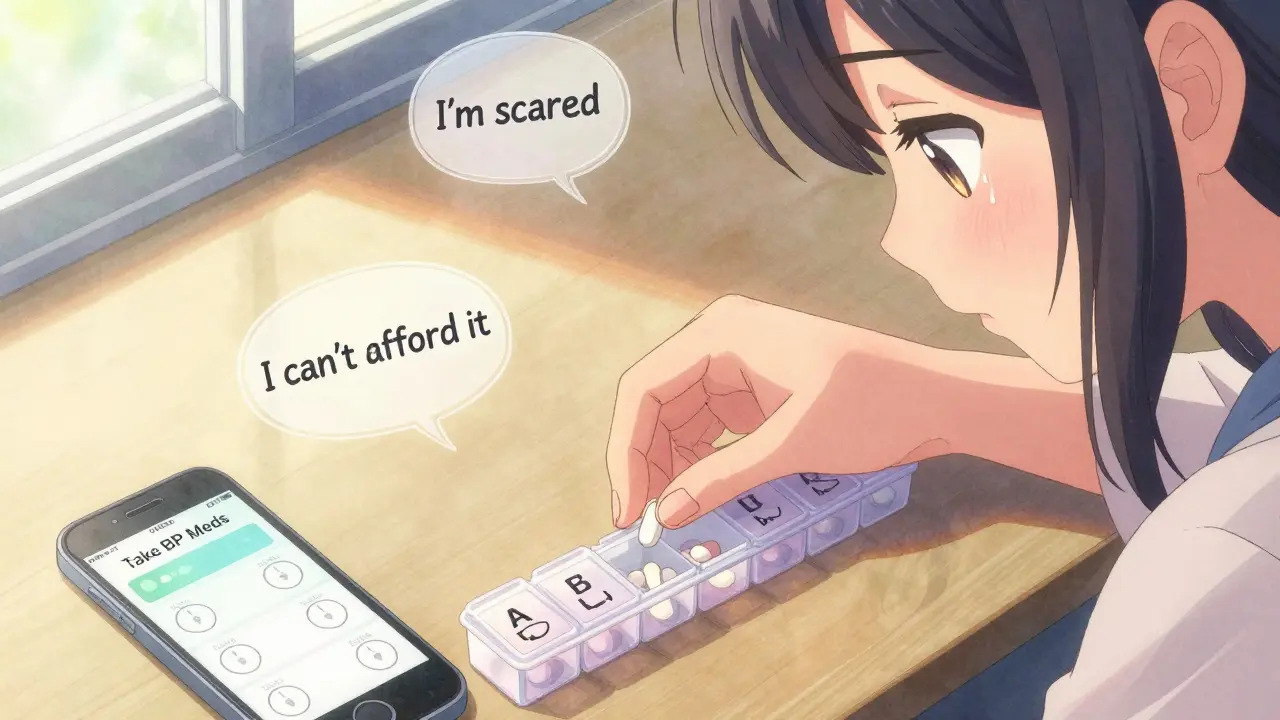
You’re not alone if you’ve skipped a dose because:
- The pill made you dizzy
- You forgot after the first week
- You’re scared of side effects
- You can’t afford it
- You don’t understand why you need it
But if you don’t tell your doctor, they can’t help. They can’t switch your pill. They can’t lower the cost. They can’t explain it differently. They don’t know you’re struggling.
Try this script: ‘I’ve been having trouble with [medication]. I’ve missed doses because [reason]. I’m worried it’s not working, or maybe it’s making things worse.’ That’s it. No excuses. No guilt. Just facts.
One patient on Reddit shared: ‘When my doctor said, “Lots of people forget pills,” I finally told him I wasn’t taking my blood pressure meds. We changed the schedule. My numbers dropped in two weeks. That conversation saved my life.’
How to Make Sure You Understand What They Tell You
Half of all patients leave the office not remembering what they were told. That’s not your fault. It’s the system’s failure.
Ask for the teach-back method. It’s simple: After your doctor explains your meds, say, ‘Can you help me explain this back to you so I’m sure I got it right?’ Then say it in your own words.
Example: If they say, ‘Take this pill once a day with food,’ you say, ‘So I take one blue pill every morning after breakfast, not on an empty stomach?’ If you’re wrong, they correct you. If you’re right, you leave confident.
This one technique boosts adherence by 17%. It takes less than a minute. And it’s used by top hospitals - because it works.
What to Do When Your Doctor Doesn’t Ask
Not all doctors are trained in communication. Some still think their job ends at writing the prescription. If yours doesn’t bring up adherence, you have to.
At the start of your visit, say: ‘I want to make sure I’m taking my medicines right. Can we go over them together?’ Bring a list. Write down names, doses, times. Highlight any that you’ve skipped.
Bring a friend or family member if you’re nervous. They can help remember what was said. Or use your phone to record the conversation - ask permission first, but most doctors are okay with it.
And if your doctor gets defensive? That’s a red flag. Good doctors don’t scold. They ask: ‘What’s making this hard for you?’ If they blame you, it’s time to find someone who listens.
Barriers That Stop People - And How to Overcome Them
Cost is the #1 reason people skip pills. If your medicine is too expensive, say so. There are options: generic versions, patient assistance programs, pharmacy discount cards. Your doctor can help you find them - but only if you speak up.
Side effects? Don’t just quit. Tell your doctor what you’re feeling. Sometimes a small change - taking it at night instead of morning, or with a snack - fixes it. Other times, there’s a different drug with fewer issues.
Memory problems? Use a pill organizer. Set phone alarms. Link taking pills to something you do every day - brushing teeth, eating lunch. Simple habits stick.
Low health literacy? You’re not dumb. You just weren’t taught how to read medical info. Ask for simpler explanations. Say: ‘Can you explain this like I’m 12?’ Most doctors will try.

What Happens When You Don’t Talk
One patient stopped taking her transplant meds after her doctor yelled at her for missing one dose. She felt ashamed. She lied for months. Then her body started rejecting the organ. She ended up back in intensive care.
That’s not rare. A 2021 study found 42% of non-adherent patients said their doctor reacted negatively when they admitted they weren’t taking their meds. Shame doesn’t motivate. It silences.
Meanwhile, patients who talk to their doctors have 22% fewer medication errors. They’re 30% less likely to be readmitted. Their hospital stays are shorter. Their costs drop. Their lives get better.
Communication isn’t just polite. It’s life-saving.
What’s Changing - And Why It Matters
Hospitals in the U.S. are now required to check medication adherence before discharge - or they lose money. Insurance companies are tying payments to how well patients stick to their plans. That’s pushing clinics to train staff in communication.
AI chatbots are popping up to remind people to take pills. But studies show they’re only half as effective as a real conversation. The best results come when tech supports people - not replaces them.
And now, the American Medical Association requires doctors in value-based care programs to prove they’re using communication skills. That means more training. More time. More listening.
This isn’t just about pills. It’s about trust. It’s about dignity. It’s about being seen as a person, not a chart.
Start Today - One Conversation at a Time
You don’t need to be perfect. You don’t need to take every pill every day. But you do need to be honest.
Next time you see your doctor, bring your meds. Write down your questions. Say what’s really going on. If they don’t respond with care, find someone who will.
Medication adherence isn’t about willpower. It’s about partnership. And you have the right to be heard.

Gaurav Meena
January 29, 2026 AT 16:36Jodi Olson
January 30, 2026 AT 12:47Carolyn Whitehead
January 31, 2026 AT 19:25Katie and Nathan Milburn
January 31, 2026 AT 21:51Beth Beltway
February 2, 2026 AT 01:11Marc Bains
February 3, 2026 AT 17:06Rob Webber
February 5, 2026 AT 14:35Yanaton Whittaker
February 6, 2026 AT 08:43Holly Robin
February 6, 2026 AT 19:47Sazzy De
February 8, 2026 AT 17:43