How to Keep a Symptom Diary for Suspected Drug Reactions
 May, 24 2026
Imagine taking a new medication for back pain. Two days later, you feel dizzy and nauseous. Is it the pill? Or is it just stress from work? Without proof, your doctor might shrug it off as a coincidence. But if you have a detailed log showing exactly when you took the dose and when the dizziness started, that guesswork disappears. This is why keeping a symptom diary is one of the most powerful tools you have when suspecting a bad reaction to a drug.
Most people rely on memory during medical visits, but human memory is notoriously unreliable, especially under stress. Studies show that documenting symptoms in real-time reduces false reports by over 60%. By creating a clear timeline between your medication and your physical response, you give healthcare providers the concrete evidence they need to adjust your treatment safely and quickly.
Why Your Memory Isn't Enough
We often think we remember details clearly, but cognitive research tells a different story. According to guidelines from the National Institute on Aging (NIA), memory degradation begins within 48 hours of an event. If you wait until your next appointment-often weeks away-to tell your doctor about a rash or headache, the critical timing data is gone.
Expert consensus from the International Society of Pharmacovigilance highlights that symptom diaries outperform patient recall alone by 83% in establishing links between drugs and adverse events. The key isn't just writing things down; it's doing so contemporaneously. When you write down a symptom minutes after it happens, you capture the nuance that fades later: the exact shade of a rash, the precise moment nausea hit, or the specific activity you were doing.
Consider this scenario: A patient complains of general fatigue. Without a diary, a doctor might assume it's depression or aging. With a diary, the patient shows that fatigue spikes exactly four hours after taking their blood pressure medication. That pattern changes the diagnosis entirely. Dr. Sarah Ahmed, Director of the FDA's Division of Pharmacovigilance, notes that precise timing documentation is crucial for determining causality, especially for time-sensitive reactions like anaphylaxis.
The Nine Essential Data Points
A napkin with "felt sick" written on it doesn't help anyone. To make your diary useful, it needs structure. The NIA Adverse Event Guidelines specify nine core elements you should track for every entry. You don't need a PhD to understand them, but you do need to be consistent.
- Date and Time: Record the exact minute you took the medication and the exact minute symptoms started. Use a 24-hour clock to avoid AM/PM confusion.
- Dosage and Route: How much did you take? Was it a tablet, liquid, injection, or patch?
- Concurrent Medications: List everything else you took, including over-the-counter painkillers, vitamins, and herbal supplements. Interactions are common culprits.
- Symptom Description: Be specific. Instead of "stomach hurt," write "burning sensation in upper abdomen." Note the anatomical location.
- Onset Relative to Drug: Calculate the gap. Did symptoms start 15 minutes after dosing? Four hours later? This interval is vital for doctors.
- Duration: How long did the symptom last? Did it fade slowly or stop abruptly?
- Environmental Factors: Were you stressed? Exercising? In a hot room? These context clues help rule out non-drug causes.
- Remedial Actions: Did you take antacid? Rest? Drink water? Did anything make it better or worse?
- Resolution Status: Did the symptom go away completely, partially, or persist?
Harvard's DF/HCC guidance also recommends using a severity scale. You don't need complex medical jargon. Simply rate symptoms from 1 (mild, barely noticeable) to 5 (life-threatening). This helps your doctor prioritize which issues need immediate attention.
Paper vs. Digital: Choosing Your Tool
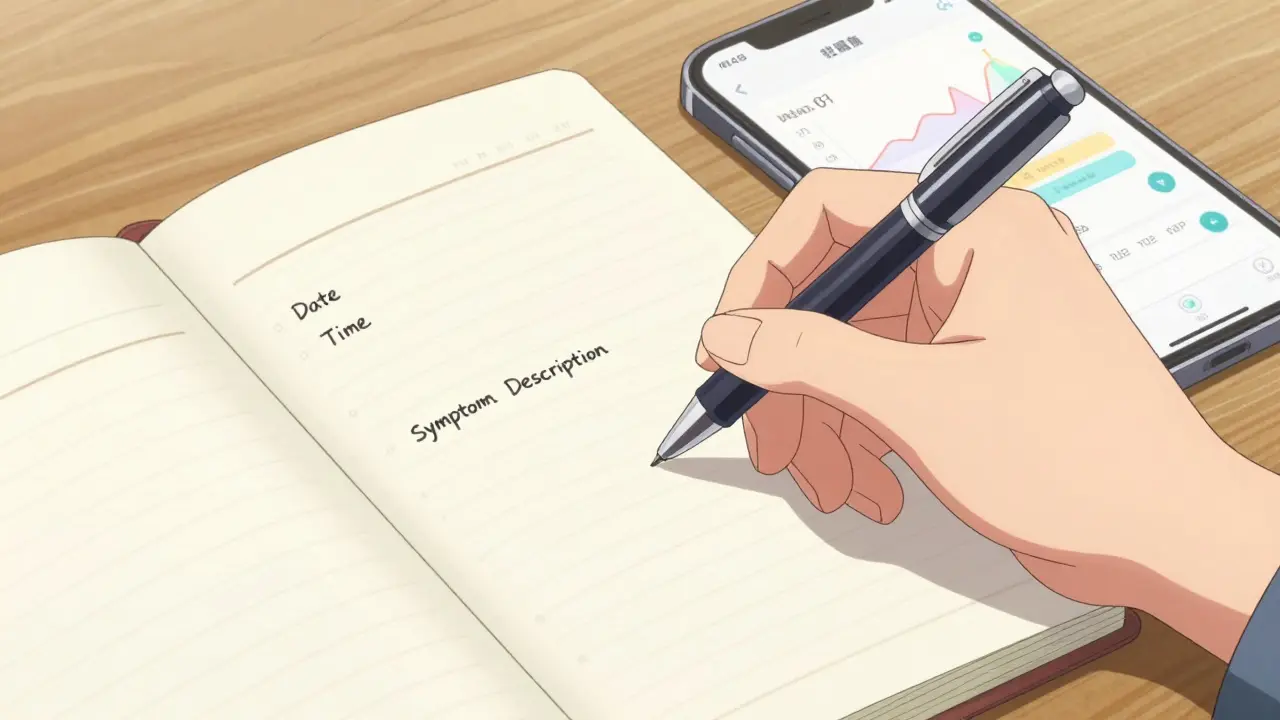
You can keep a symptom diary in a notebook or on your phone. Both work, but they have different strengths and weaknesses. The choice depends on your lifestyle and how tech-savvy you are.
| Feature | Paper Diary | Digital App (e.g., Medisafe, MyTherapy) |
|---|---|---|
| Setup Time | Immediate (pen and paper) | 1-2 hours to configure alerts |
| Timestamp Accuracy | Manual entry (prone to error) | Automatic (highly accurate) |
| Visual Evidence | Difficult (requires photos taped in) | Easy (attach photos directly) |
| Data Analysis | None (you must spot patterns) | Charts and correlation graphs |
| Abandonment Rate | High (57% for unstructured logs) | Lower (22% with reminders) |
| Privacy | Physical security risk | Encryption and cloud backup |
Digital apps like Medisafe, CareClinic, and MyTherapy have become popular since the early 2010s. They automatically timestamp entries, which solves the biggest problem with paper diaries: inconsistent timekeeping. In fact, synchronizing logs with smartphone health apps has been shown to reduce timing errors by 82%.
However, digital tools aren't perfect. Some users find the setup tedious. If you prefer simplicity, a structured paper template with checkboxes for common symptoms can increase completion rates by 67%. The European Medicines Agency (EMA) found that adding photographic documentation to diaries increased diagnostic accuracy for skin reactions by 78%. If you're tracking rashes or swelling, a camera-equipped phone is invaluable.
Avoiding Common Pitfalls
Even with the best intentions, many symptom diaries fail. Why? Usually because they contain too much noise or miss critical details. Dr. Michael Cohen from the Institute for Safe Medication Practices warns that over-documenting minor, expected side effects can obscure serious reactions. In his 2022 study, 41% of reviewed diaries contained excessive irrelevant data that delayed proper intervention by an average of three days.
Here’s how to stay on track:
- Focus on Unexpected Changes: If your doctor told you mild drowsiness was normal, you don't need to log every yawn. Log the sudden fainting spell instead.
- Don't Skip Concurrent Meds: Seventy-one percent of error cases in diaries involve failing to document other medications. If you take aspirin, ibuprofen, or even St. John's Wort, write it down. Interactions are sneaky.
- Be Objective: Instead of writing "I felt terrible," measure what you can. Use a thermometer for fever, a pulse oximeter for oxygen levels, or a blood pressure cuff. Objective data carries more weight than subjective feelings.
- Keep It Brief: Aim for 2-5 minutes per entry. If it takes longer, you'll quit. Scripps Research found that 57% of patients abandon unstructured paper logs within 72 hours due to complexity.
Another major hurdle is knowing what counts as a "reportable" symptom. Many patients hesitate, fearing they are being dramatic. Remember: it is better to record something that turns out to be unrelated than to miss a warning sign. Your job is to collect data; your doctor's job is to interpret it.
Making Your Doctor Listen
Having a diary is only half the battle. You also need to present it effectively. Most patients crumple up their notes and hand them over at the end of the visit. Don't do that. Bring a summary page.
Create a one-page cheat sheet that highlights the strongest correlations. For example: "Every time I take Drug X at 8 PM, I experience heart palpitations within 30 minutes." Show the raw data only if asked. Doctors are busy; they appreciate concise insights backed by detailed evidence.
Real-world feedback supports this approach. On Reddit's r/Pharmacy community, 68% of surveyed patients reported improved communication with providers after maintaining a diary. One user shared how their neurologist dismissed complaints of dizziness until they presented a 14-day diary linking levodopa doses to symptom spikes. The regimen was adjusted within 48 hours.
If your doctor seems dismissive, ask specifically: "Based on this timeline, could this be an adverse drug reaction?" This shifts the conversation from vague complaints to clinical investigation. In New Zealand, where healthcare resources are stretched, providing clear evidence can significantly speed up referrals to specialists or pharmacists for review.

When to Seek Immediate Help
A symptom diary is a monitoring tool, not a substitute for emergency care. Certain reactions require immediate action, regardless of whether you've logged them. Stop the medication and seek help if you experience:
- Difficulty breathing or swallowing
- Swelling of the face, lips, or tongue
- Severe rash with blistering or peeling skin
- Chest pain or irregular heartbeat
- Sudden, severe headache or vision changes
These signs may indicate anaphylaxis or other life-threatening conditions. Do not wait to see if they improve. Call emergency services immediately. Once stabilized, bring your diary to the hospital to help the team identify the trigger quickly.
Future Trends in Symptom Tracking
The way we track drug reactions is evolving. The FDA recently launched pilot programs integrating symptom diary data directly into electronic health records via FHIR APIs. This means your app could automatically flag potential adverse events to your doctor before you even sit down in the exam room.
Artificial intelligence is also entering the space. Platforms like Google Health's Verily are testing AI models that predict drug-adverse event relationships from structured diary data with high accuracy. While regulatory acceptance is still pending, these tools promise to reduce the burden on patients by automating pattern recognition.
For now, the most effective strategy remains simple: consistency. Whether you use a pen or an app, the goal is the same. Capture the truth of your body's response while it's fresh. That clarity empowers you to take control of your health and ensures your medical team has the facts they need to keep you safe.
How long should I keep a symptom diary?
Aim for at least two weeks of continuous tracking. This duration usually captures enough data points to identify patterns, especially if you take medication daily. For intermittent medications, track until you have recorded at least five separate doses and their associated responses. Clinical research suggests that two-week diaries can reduce diagnostic testing requirements by 37%.
Should I stop taking my medication while keeping a diary?
Never stop prescribed medication without consulting your doctor first. Abruptly stopping certain drugs can cause withdrawal symptoms or worsen your condition. Use the diary to gather evidence, then discuss your findings with your healthcare provider to decide on the next steps together.
What if I forget to log a symptom immediately?
Log it as soon as you remember, but note that it is a retrospective entry. Write "Recalled later" and estimate the time as best as you can. While immediate logging is ideal for accuracy, partial data is still better than no data. Try setting phone alarms to remind you to check in with your body at regular intervals.
Can I use my symptom diary for legal purposes?
Yes, a well-maintained symptom diary can serve as valuable evidence in cases of suspected pharmaceutical harm. Courts and insurance companies often look for contemporaneous documentation to establish causality. Ensure your entries are dated, timed, and factual, avoiding emotional language. Digital apps with automatic timestamps are particularly strong for verification.
Are digital symptom diaries private and secure?
Reputable health apps comply with data protection regulations like HIPAA in the US or Privacy Act standards in New Zealand. Look for apps that mention encryption and offer local storage options. Avoid sharing your diary publicly on social media. Always read the privacy policy to understand how your health data is stored and who has access to it.
